




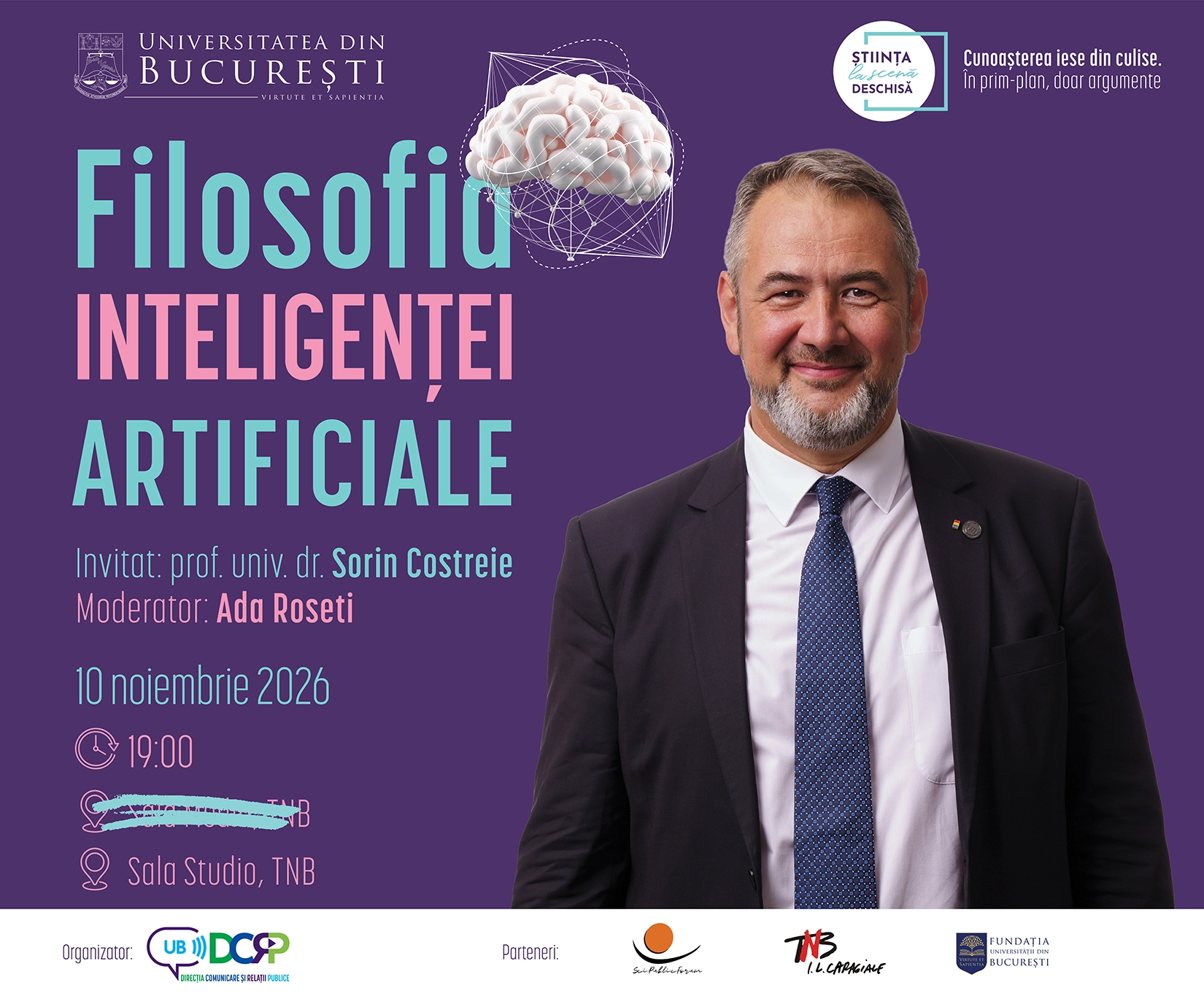
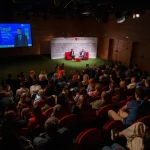
The University of Bucharest (UB) will officially open its 2026–2027 season on Tuesday, 10 November 2026, with a new edition of its lecture series, “ Science on the Open Stage”. The event will feature professor Sorin Costreie, PhD, philosopher, Romania’s Minister of Education and Research, and member of the Faculty of Philosophy at the University of Bucharest. The conference, titled “The Philosophy of Artificial Intelligence,” invites audiences to reflect on one of the most significant technological transformations of our time and the fundamental questions it raises about thinking, knowledge and the nature of intelligence. The conference is organised by the University of Bucharest, through its Communication and Public Relations Department, in collaboration with the “SciPublic Forum” Association, and it will take place in the “Studio” Hall of the “I. L. Caragiale” National Theatre in Bucharest, starting 7 PM. Entrance is free, subject to availability, with a capacity of 100 places. Advance reservation is required by filling in the form available here, and the event is open to the general public.
Artificial intelligence has become part of our everyday lives in a remarkably short time. It writes, translates, generates images, solves problems, formulates arguments and produces answers that increasingly resemble those of a human interlocutor. But how much of what we call “intelligence” is actually found in these systems? What does it mean to understand, reason or know? And, above all, what does the emergence of artificial intelligence tell us about our own intelligence?
Can machines think? Can an artificial system understand or does it merely process information? Is artificial intelligence a form of knowledge, or is it a tool that imitates the ways in which we produce and communicate knowledge?
Starting from these questions, professor Sorin Costreie will take the audience on an incursion into the philosophy of artificial intelligence, at the intersection between philosophy of mind, philosophy of language, logic, philosophy of science and epistemology.
The topic has never been more relevant than in our current times, when – in education and research – the emergence of AI-powered tools is bringing long-standing questions back into focus: what does learning mean, what constitutes originality and authorship, how should knowledge be assessed, and what roles should teachers and researchers play?
For professor Sorin Costreie, examining how artificial intelligence challenges and reshapes our relationship with humanism and the values of contemporary society, as well as reflecting on these transformations, is a natural extension of his academic work. A faculty member of the Department of Theoretical Philosophy at the University of Bucharest’s Faculty of Philosophy, professor Costreie specialises in philosophy of language, philosophy of mathematics and philosophical logic, while his areas of expertise include logic, philosophy of science, metaphysics, epistemology, philosophy of mind and critical thinking. He has conducted research in Italy, Germany, Spain, the United States and Canada, and has published works in international volumes and academic journals. His academic career is complemented by substantial experience in university management and public administration. He has served as Director of the Department of Quality Management, Vice-Dean of the Faculty of Philosophy and Vice-Rector of the University of Bucharest. In central government, he held the positions of Secretary of State at the Ministry of Education and State Counselor for Education and Research within the Prime Minister’s Chancellery. In November 2025, he was appointed Presidential Adviser for Education and Research within the Presidential Administration, a position he held until his appointment as Minister of Education and Research in October 2026.
At European level, professor Sorin Costreie has served since 2023 as President of UNICA – Network of Universities from the Capitals of Europe, which brings together universities from European capital cities. His term of office is four years. He also coordinates the CIVIS European University Alliance at the University of Bucharest, contributing to the development of cooperation among its 11 partner universities and to consolidating the European dimension of higher education and research.
This dual perspective – that of a philosopher concerned with the nature of thought and knowledge, and that of a professor and university administrator involved in the transformation of European education – provides a distinctive framework for discussing artificial intelligence and its impact on how we learn, conduct research and understand the world.
The topic of artificial intelligence therefore takes on two complementary dimensions at this meeting: that of the philosopher interested in the nature of knowledge, language and thought, and that of the minister responsible for addressing technological transformations from the perspective of education and research.
The University of Bucharest’s “Science on the Open Stage” conference series
The conference series “Science on an Open Stage” is organised by the Communication and Public Relations Department of the University of Bucharest in collaboration with the “SciPublic Forum” Association and aims to break traditional barriers between the academia and the general public by offering a platform where specialists from various fields can discuss current topics.
The speakers are professors, researchers and prominent figures from different scientific disciplines. By fostering meaningful connections between the academic community and the wider public, the series does more than simply “explain” science: it presents science as a spectacle of knowledge, in which fundamental themes about reality are passed through the filter of solid arguments and audiences are encouraged to take an active part in the discussion.
The event is constructed in a dynamic format designed to facilitate both an understanding of the subject and genuine dialogue with the audience.
The conference will begin with a lecture of approximately 20 minutes, dedicated to explaining the key concepts, followed by a brief five-minute Q&A session designed to reinforce the main ideas. Next, the speaker will propose an applied section lasting approximately 15 minutes, illustrating the concepts discussed through concrete examples, case studies or situations relevant to everyday life. The event will end with an extended Q&A session of approximately 40 minutes, encouraging active audience participation and further exploration of topics of interest.
The “Science on the Open Stage” conference series reaffirms the University of Bucharest’s commitment to making high-quality science accessible to the general public and to educating, inspiring and connecting people across Romania. The initiative comes at a time when discussions about the role of science in society – from global challenges such as climate change and public health to critical thinking and democracy – are essential to help citizens become informed and responsible. With this goal in mind, the University of Bucharest has launched an extensive Science Communication Programme, aimed at promoting the scientific work of its academic community and facilitating dialogue between researchers and the general public. Two of the University of Bucharest’s most recent initiatives in this area are the platforms hartacercetatorilor.ro and descopeRO.unibuc.ro, which complement its lectures and multimedia research outreach series, including UB Science Dose, microSCOPE: UB Researcher at the Microphone, Project Under the Microscope, ICUB Meetings and Conversations with SKEPSIS.
Postări asemănătoare:
 The University of Bucharest launches the “Science on the open stage” lecture series. The first guest, Professor Carmen Chifiriuc, PhD, invites the public on a journey into the universe of the microbiome
 University of Bucharest undergraduate and master’s students invited to attend Romania’s first modular course dedicated to hybrid warfare, delivered by Professor Corneliu Bjola (University of Oxford)
 The University of Bucharest launches the “Science on the open stage” lecture series. The first guest, Professor Carmen Chifiriuc, PhD, invites the public on a journey into the universe of the microbiome
 “Time Is the Only Capital We Are Born With” – Professor Marian Preda, Guest of the Third Edition of the “Science on the Open Stage” Conference Series
