




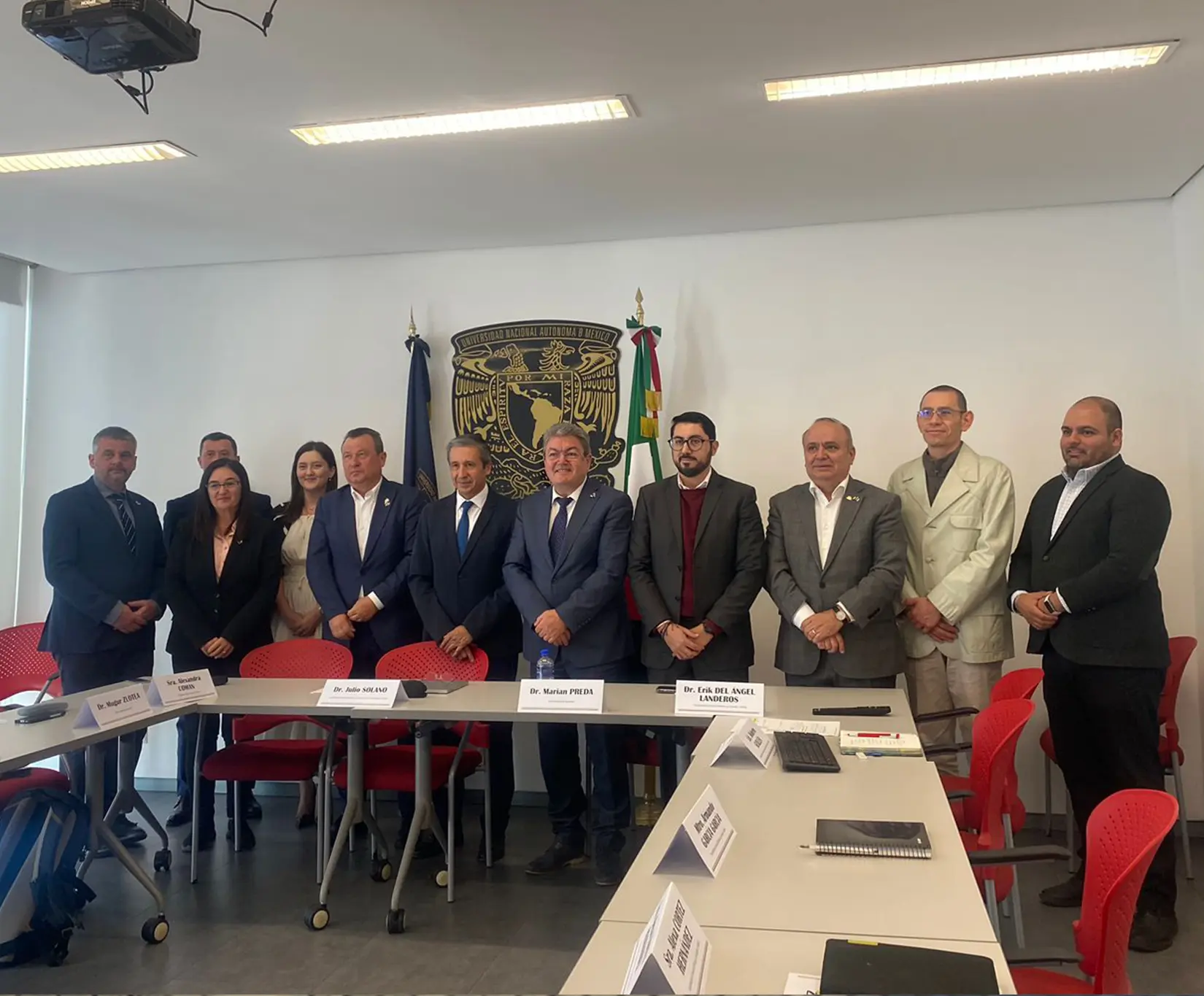
In the context of its participation in the BMI Global Student Fair LATAM 2026, held between February 28 and March 2, 2026, in Mexico City, a delegation from the University of Bucharest paid an official visit on Monday, March 2, 2026, to the Universidad Nacional Autónoma de México (UNAM). The meeting with members of UNAM’s leadership aimed to strengthen bilateral cooperation and identify new directions for academic and scientific collaboration.
The University of Bucharest delegation included Prof. Marian Preda, Rector of the University of Bucharest, Assoc. Prof. Mugur Zlotea, Vice-Rector for International Relations, Public Relations and Students, and Assoc. Prof. Mihai Enăchescu, Director of the Department of Romance, Classical and Modern Greek Languages and Literatures at the Faculty of Foreign Languages and Literatures.
The University of Bucharest – “a gateway to Europe”
In his remarks, Prof. Dr. Marian Preda highlighted the university’s strong international profile and its consolidated role within the CIVIS – European Civic University Alliance, one of the most dynamic cooperation structures in the European higher education landscape. CIVIS is the result of transnational collaboration among civic universities and brings together over 400,000 students and 55,000 members of the academic community, promoting a multilingual and multicultural environment. The founding member universities include Aix-Marseille University (France), the National and Kapodistrian University of Athens (Greece), the Free University of Brussels (Belgium), the University of Bucharest (Romania), the Autonomous University of Madrid (Spain), Sapienza University of Rome (Italy), Stockholm University (Sweden), and the University of Tübingen (Germany). In December 2020, the University of Glasgow joined the alliance as an associate partner following approval from the European Commission, while in October 2021, Paris Lodron University of Salzburg (PLUS) became the alliance’s tenth member. Starting October 1, 2022, with the official accession of the University of Lausanne (UNIL), the CIVIS community expanded to 11 member universities.
Through the “open campus” concept, students and academic staff from member universities have access to the facilities and resources of partner institutions. Rector Marian Preda noted that approximately 400 mobility opportunities were available for University of Bucharest students within the alliance during the 2024–2025 academic year.
“The University of Bucharest can serve as a gateway to Europe for you. We see ourselves as a true network of networks – through the alliances and academic networks we are part of, from CIVIS to regional networks in the Black Sea and Balkan regions, we can facilitate connections with academic and scientific communities across Europe,” the Rector emphasized.
He also highlighted the University of Bucharest’s involvement in networks such as the Black Sea Universities Network, the Balkan Universities Association, and UNICA – Network of Universities from the Capitals of Europe, noting that these platforms further expand cooperation opportunities for the university’s international partners.
A diverse academic portfolio and competitive research infrastructure
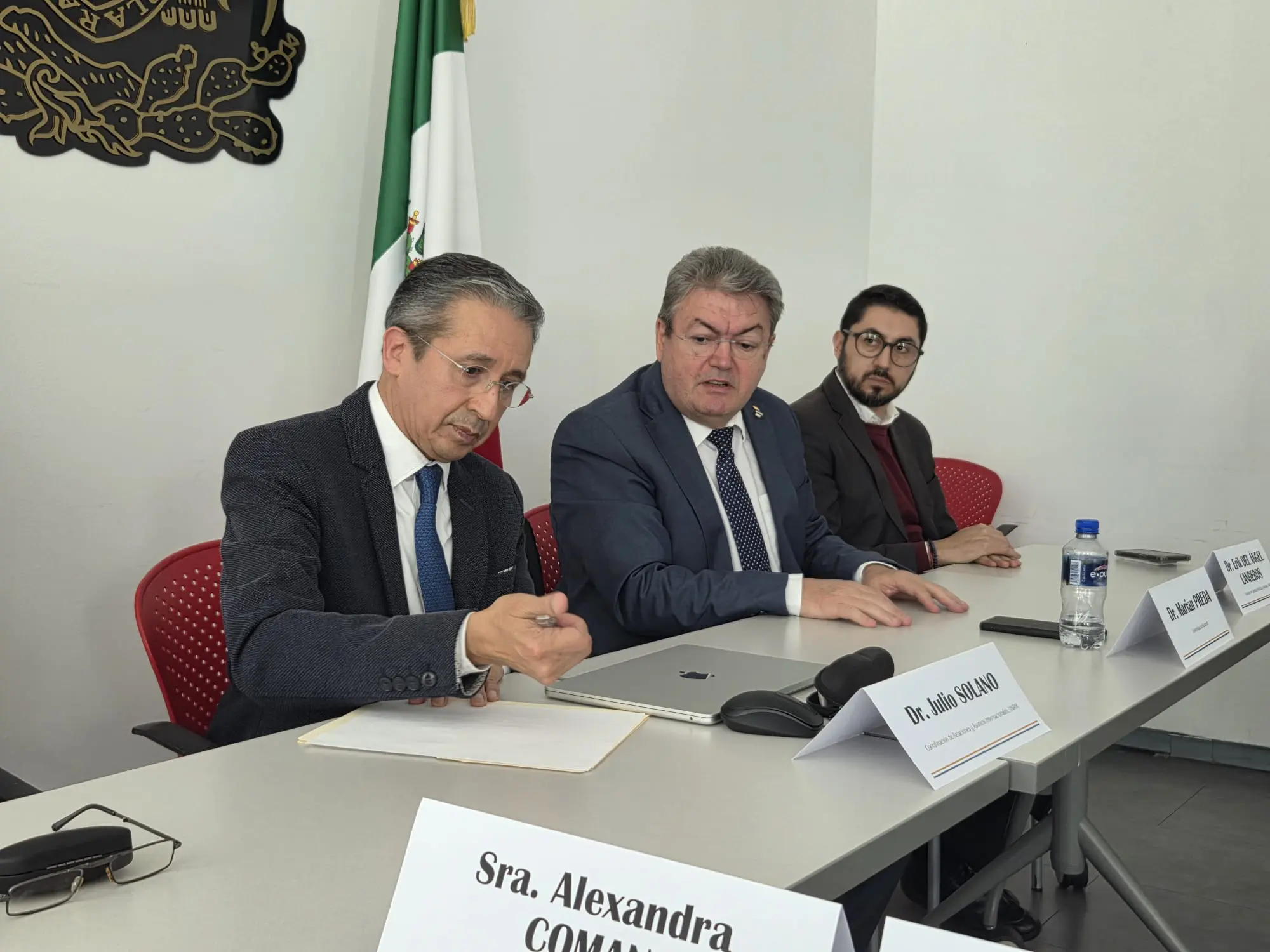
Regarding the university’s academic and research profile, Rector Marian Preda emphasized that the University of Bucharest covers a broad range of disciplines, from exact and natural sciences to social sciences and humanities.
“We cover many of the fields you mentioned as well, from physics, biology, and earth sciences to political science, public administration, international relations, and sociology. In physics, we offer five programs taught in English and collaborate with leading research infrastructures, including projects connected to the most powerful laser in the world, located just a few kilometers from Bucharest, in Măgurele, at the Extreme Light Infrastructure – Nuclear Physics (ELI-NP) research center. We also have strong expertise in biology, gerontology, nutrition, as well as in earthquake research,” the Rector noted.
In the field of social sciences and humanities, he highlighted programs in political science, European studies, and journalism, as well as the extensive academic offering of the Faculty of Foreign Languages and Literatures, where 33 foreign languages are studied. In this context, he also mentioned the contributions of Assoc. Prof. Mugur Zlotea, Vice-Rector for International Relations, Public Relations and Students and a professor of Chinese at the faculty, and Assoc. Prof. Mihai Enăchescu, Director of the Department of Romance, Classical and Modern Greek Languages and Literatures.
Advantages for international students
Another key point addressed during the meeting was the attractiveness of the University of Bucharest for international students.
“Bucharest and the surrounding region represent one of the most developed areas in Europe, with a dynamic economic environment and numerous professional opportunities for students. At the same time, the cost of living remains affordable compared to other European capitals. Tuition fees are competitive, and students benefit from reasonable accommodation options. All these factors make the University of Bucharest an attractive academic destination for young people seeking a complete European experience,” the Rector said.
Academic cooperation and joint projects
An important part of the discussions focused on the existing agreement between the University of Bucharest and the Universidad Nacional Autónoma de Méxicoin the fields of geography and geology, as well as the shared interest in expanding mobility programs for students, faculty members, and researchers, and developing joint research projects.
During the meeting, participants also mentioned the presence of Romanian researcher Marina Manea at UNAM, including her involvement in coordinating doctoral-level academic structures.
Representatives of the University of Bucharest also presented funding opportunities and programs for international researchers offered through the University of Bucharest Research Institute (ICUB):
Fellowships for Young Researchers – residential fellowships for early-career researchers with excellent research activity who obtained their PhD within the last seven years. The fellowship duration ranges from three to twelve months, and applications can be submitted throughout the year. During the program, fellows become full members of the ICUB and University of Bucharest academic community.
Fellowships for Visiting Professors – designed for experienced researchers with proven international activity who wish to conduct research projects within ICUB. Activities may include organizing scientific events (conferences, presentations, colloquia, workshops), writing grant applications, and providing mentorship and consultation for postdoctoral researchers and fellows.
ERC Pre-Project Scholarships – aimed at supporting outstanding researchers in transforming their ideas into competitive applications for European research funding programs, initially focusing on European Research Council (ERC) grants (Starting Grants, Consolidator Grants, Advanced Grants, Synergy Grants), with the possibility of extending to Horizon Europe or bilateral research projects.
Representatives of the Universidad Nacional Autónoma de México expressed their interest in increasing the number of bilateral mobility opportunities. The discussions also explored potential collaboration in fields such as public administration, international relations, sociology, and anthropology, as well as the possibility of developing joint projects within European funding programs.
The visit of the University of Bucharest delegation to UNAM highlighted the shared interest in expanding and deepening academic cooperation between the two institutions. The dialogue held in Mexico City confirmed the existence of strong areas of convergence and the willingness of both sides to develop academic mobility initiatives and collaborative research projects.
The meeting opened concrete prospects for medium- and long-term institutional collaboration, bringing closer together two academic environments that share both cultural affinities and scientific interests.
Postări asemănătoare:
 The University of Bucharest Received the Visit of a UNESCO Delegation
 Professor Marian Preda, rector of the University of Bucharest and president of the Black Sea Universities Network, official visit to Turkey
 Professor Marian Preda, UB Rector and President of the Black Sea Universities Network, official visit to Azerbaijan
