




The Sultana-Malul Roșu archaeological site, located in Mânăstirea, Călărași County, is considered one of Romania’s most spectacular archaeological locations. It holds the distinction of being the first site where scientific research was conducted on the Gumelnița culture.
Located on a high terrace on the right side of the Mostiștea Valley, on the shores of Lake Iezerul Mostiștea, Sultana-Malul Roșu is one of the most representative and prolific Neo-Eneolithic archaeological sites in the country. With a long tradition of research beginning in 1923, the site has yielded artifacts of exceptional cultural value—some of which are unique worldwide. Notable among these are the “Lovers’ Vessel,” two “Goddesses,” and a series of objects crafted from exotic raw materials such as gold, copper, malachite, or Mediterranean shells, all of which are remarkable for both their craftsmanship and durability.
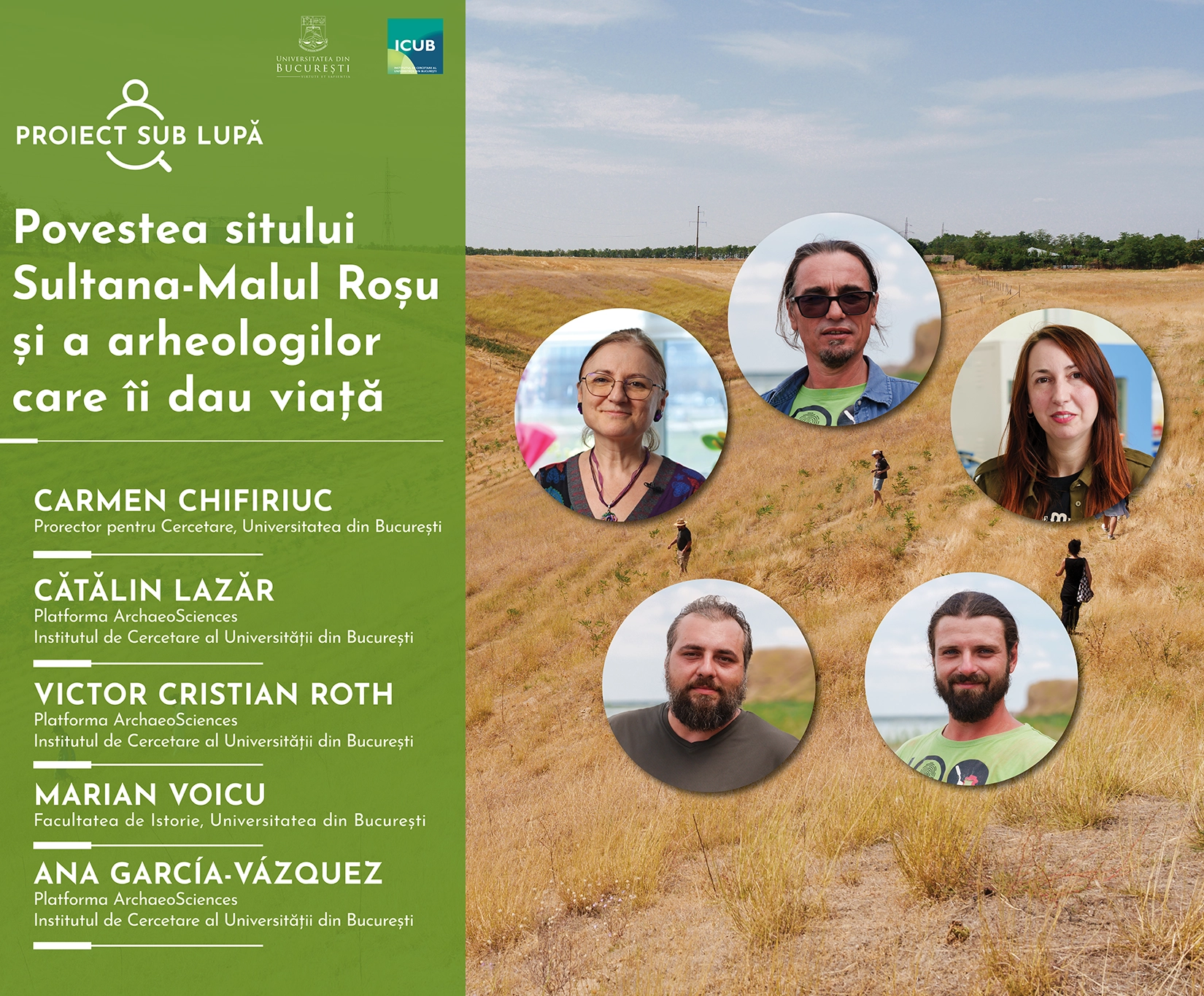
In this context, the “Project Under the Lens” team traveled to both the Sultana-Malul Roșu site and the ArchaeoSciences laboratories to interview archaeologists Cătălin Lazăr, Victor Cristian Roth, Marian Voicu, and Ana García-Vázquez, as well as the Vice-Rector for Research at the University of Bucharest, biologist Carmen Chifiriuc, regarding why this archaeological site is so significant for Romania, what it reveals about archaeological research both nationally and globally, but also the vital role of interdisciplinarity in investigating essential phenomena in the evolution of human society.
We invite you to watch the resulting material in the seventh episode of the “Project under the Lens” Series, which can be accessed by clicking below.
First excavated in 1923 by Professor Ioan Andrieșescu and his student, Vladimir Dumitrescu, the Sultana-Malul Roșu site revealed, for the first time, a settlement belonging to the Gumelnița culture (c. 4600–3900 BCE).
Having passed through various stages—dictated by shifting scientific interests and the country’s socio-political evolution—research was resumed in 2001 at the initiative of Professor Radian Andreescu. This occurred within the framework of the multidisciplinary project “The Beginnings of European Civilization: The Neo-Eneolithic on the Lower Danube,” which introduced an interdisciplinary approach that was unique in Romania at that time.
Today, research coordination is led by Dr. Cătălin Lazăr from the Research Institute of the University of Bucharest (ICUB), assisted by Dr. Theodor Ignat from the Bucharest Municipality Museum, also an associate researcher at ICUB.
Currently, the scientific research at Sultana-Malul Roșu, under the patronage of the University of Bucharest, is systematic and ongoing. It involves the combined efforts and collaboration of several national (University of Bucharest, Bucharest Municipality Museum, “Vasile Pârvan” Institute of Archaeology, Gumelnița Civilization Museum in Oltenița and Lower Danube Museum in Călărași) and international (Christian-Albrechts-Universität zu Kiel – Germany, HOGENT – Belgium) institutions.
Research efforts include non-intrusive terrestrial, aerial, and underwater surveys, core sampling, as well as studies in archaeozoology, archaeobotany, malacology, carpology, physical and cultural anthropology, and anthracology. These are complemented by extensive studies on flint tools, hard animal materials, and ceramics—conducted through experimental archaeology—and further supported by complex molecular investigations such as stable and radiogenic isotopes and DNA analysis.
Based on these facts and considering the undeniable importance of the site, we invited a few members of the research team who bring this site to life to tell us its story and speak about the past, present, and future of the archaeological profession.
- Why is the archaeological research at the Sultana-Malul Roșu site important?
- When and how did research at this site begin?
- What distinguishes this archaeological site from others, and what does it represent for the archaeologists who study it?
- What is the role of the ArchaeoSciences platform and the Sultana-Malul Roșu archaeological site within the University of Bucharest’s research ecosystem?
- How interdisciplinary is the research at the Sultana-Malul Roșu archaeological site?
- How and why does an archaeologist end up at Sultana-Malul Roșu?
- What does fieldwork look like and how is it carried? What does a day of fieldwork look like for an archaeologist?
- What have been the moments of greatest satisfaction experienced by the archaeologists at Sultana-Malul Roșu?
- What happens to the data collected during fieldwork, and how do these discoveries end up in high-impact publications?
- How does collaboration look like within a team of archaeologists with such different profiles and backgrounds?
- What might motivate a young person to pursue archaeology?
- What do young people visiting the site find the most interesting? What are the main questions they ask?
- What needs to change so that young people remain in the research field instead of moving to other sectors?
Answers to all these questions and many more are provided by the Vice-Rector for Research at the University of Bucharest, biologist Carmen Chifiriuc, and archaeologists Cătălin Lazăr, Victor Cristian Roth, Marian Voicu, and Ana García-Vázquez in the seventh edition of the Project under the Lens Series.
Carmen Chifiriuc is a biologist specializing in microbiology and immunology, as well as University Professor at the UB Faculty of Interdisciplinary Studies. Since 2019, she has served as the Vice-Rector for Research at the University of Bucharest, coordinating the scientific research activities of both the institution and the Research Institute of the University of Bucharest (ICUB). She began her research career in 1997 as a biologist in the Vibrio laboratory at the “I. Cantacuzino” National Military-Medical Institute for Research and Development in Bucharest. She was a fellow of the International Network of Pasteur Institutes in Bangui and Paris, and in 2005, she defended her doctoral thesis on the interaction between parasites and the immune status of the host. As a national manager, she contributed to the inclusion of Romania in the European Antimicrobial Resistance Surveillance System (EARSS).
She has been an active faculty member at the University of Bucharest since 2003. During this period, alongside her teaching duties, she has coordinated numerous research grants with both domestic and international funding and has been a team member for over 50 national and international research projects. Her primary research directions focus on investigating virulence and antibiotic resistance reservoirs in clinical and environmental sectors; studying host-infectious agent interrelationships, the roles of the microbiota in various pathologies, and anti-infectious immunity; developing rapid microbiological diagnostic methods; and the development and evaluation of new antimicrobial strategies with applications in the biomedical and ecological fields.
Cătălin Lazăr is a researcher at the University of Bucharest, coordinator of the ArchaeoSciences platform within the Research Institute of the University of Bucharest (ASp-ICUB), and the scientific lead for the archaeological sites at Sultana-Malul Roșu and Gumelnița. His research interests focus on the prospecting and excavation of Neolithic and Eneolithic sites, funerary behaviors, paleodemography, and mortuary practices in Southeast and Eastern Europe. Additionally, his work centers on the biocultural/geocultural identities of Neolithic communities, past population dynamics, experimental archaeology, and human-environment interaction, analyzed in correlation with various forms of geo-eco-climatic stress.
He is involved in numerous national and international research projects and has authored a wide range of specialized articles, studies, chapters, and volumes. Furthermore, he is a member of several professional associations, including the European Association of Archaeologists (EAA) and the Romanian Association of Archaeology (ARA).
Victor Cristian Roth is an archaeologist and a member of the ArchaeoSciences platform within ICUB; his path to archaeology was, as he puts it, a combination of destiny and personal choice. He attended the Art History department of the UB Faculty of History. Passionate about archaeology and prehistory, he dedicated his full attention to selecting a site for his specialized internship, relying on his own knowledge and discussions with professors at the Faculty of History. Retrospectively, his internship at the Sultana-Malul Roșu site was what cemented his professional trajectory. Joining the ArchaeoSciences team meant engaging with a wide range of disciplines—starting with the anthropomorphic figurines of the Gumelnița culture and the attempt to decipher the thought mechanisms behind them, and culminating in the application of non-intrusive prospecting in archaeological research. This latter direction represents his current field of activity and the subject he intends to deepen and expand upon in his doctoral thesis, given its massive potential for identifying and investigating areas of archaeological interest.
Marian Voicu is a political science graduate from the University of Bucharest who began his academic and research training with a seemingly simple question that spans the entire history of political thought: where do we begin when we imagine the start of society? As he explains, he quickly noticed that major political theories build their arguments upon a certain vision of the “beginning of history”—an original scene that is often idealized, speculative, or purely conceptual. To understand how much of these theoretical constructs rely on historical realities versus imagination, he chose to go into the field. For several years, he has been a constant participant in archaeological excavations at Neolithic sites, seeking to confront philosophical hypotheses with the material data of some of the earliest human societies.
Ana García-Vázquez is a bioarchaeologist with a bachelor’s degree in biology, and her research focuses on the prehistory of Europe and West Asia. Her work examines past subsistence strategies, agriculture, mobility, and human responses to environmental changes through the integrated study of human, animal, and plant remains. To address these themes, she combines stable isotope analysis, radiocarbon dating, paleoproteomics, and ancient DNA. She defended her doctoral thesis in 2015 at the University of A Coruña (Spain), graduating with the highest honors and receiving the “Extraordinary Doctorate Award.” Her doctoral research combined stable isotope analysis, ancient DNA, and morphometrics to investigate the history of Quaternary fauna in the northwest Iberian Peninsula. During her first postdoctoral stage at the University Institute of Geology (IUX) at the University of A Coruña, she expanded her methodological expertise by incorporating paleoproteomics and later specialized in ancient DNA through a research residency at the University of Potsdam (Germany).
Since 2020, she has been a postdoctoral researcher at the ArchaeoSciences Platform of the Research Institute of the University of Bucharest (ICUB), where she established and currently leads the first laboratory in Romania dedicated to the pretreatment of archaeological samples for stable isotope analysis and radiocarbon dating. Throughout her career, she has contributed to the development of new methodologies and isotopic databases (baselines) for the study of diet, herding, agriculture, and resilience to climate stress. To date, she has published 24 articles, with additional works currently under review, has secured competitive funding at both national and international levels, and has established collaborations with research teams across Europe and the United States.
The ArchaeoSciences Platform of the University of Bucharest is a component of the Research Institute of the University of Bucharest (ICUB). It aims to facilitate a complex, interdisciplinary, and integrative approach to archaeological cultural heritage through systematic and coordinated research and training activities in the fields of archaeological sciences and both tangible and intangible cultural heritage. More information about the ArchaeoSciences platform within ICUB can be accessed here.
Postări asemănătoare:
 Do we drive a golden spike at Deșli Caira? The story of a geological site ready to make history, within the fourth episode of the series “Project under the lens”
 The Journey to the Land where You Can Hear the Glaciers Cracking, and Romanian Research in Antarctica, in a new episode of the Project under the Lens series
 How do we speak about Internet of Things &Artificial Intelligence? A possible recipe for an innovative course, during the second episode of the series “Project under the lens”
 Innovative technologies in dating rocks and exploiting resources: a model of excellence in research for the benefit of society, within the third episode of the series “Project under the lens”
