




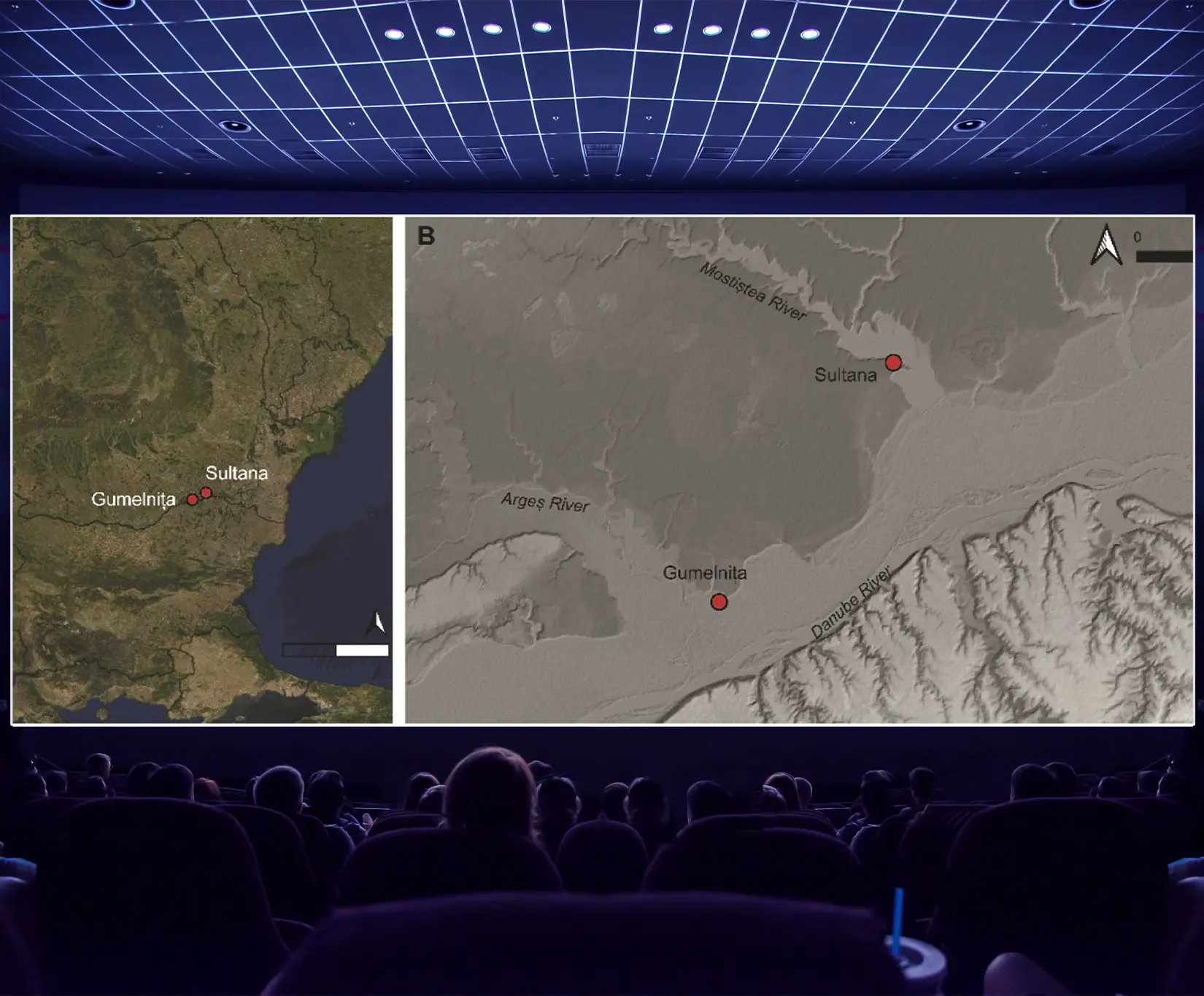
A new study published in Quaternary Environments and Humans provides fresh insights into how Chalcolithic communities at the Sultana tell settlement in Romania managed their crops during a period of hydroclimatic instability in the second half of the 5th millennium BC.
The article, entitled Managing crops under hydroclimatic instability before the 5.9 ka event: stable isotope and radiocarbon evidence from the Sultana tell (Romania), combines stable isotope analysis and direct radiocarbon dating of charred plant remains, including cereal grains and seeds of Chenopodium album. Together, these remains offer a rare opportunity to explore not only when these plants were used, but also the environmental conditions in which they grew.
The study is the result of a joint collaboration between the Romanian team, formed by members of the ArchaeoScience Platform (ASp) at the Research Institute of the University of Bucharest and the “Vasile Pârvan” Institute of Archaeology, and the German team from the Institute for Prehistoric and Protohistoric Archaeology, Kiel University.
Sultana is one of the key Gumelnița tell settlements in the Lower Danube region. During the second half of the 5th millennium BC, this area underwent major social and environmental changes. The new results suggest that crop management at Sultana took place in a context of reduced water availability and broader hydroclimatic instability before the 5.9 ka BP event, a major climatic episode recognised in different parts of the Northern Hemisphere.
By analysing the carbon and nitrogen isotope values of charred plant remains, the authors were able to investigate aspects of plant growing conditions, including water availability and soil management. Direct radiocarbon dates helped to confirm the chronological position of the archaeobotanical remains and place them within the wider sequence of occupation and environmental change at the site. Beyond cereals, the study also highlights the role of Chenopodium album, commonly known as fat-hen or white goosefoot. Although it is not a cereal crop, this plant produces edible seeds and often grows in disturbed, nutrient-rich soils, including areas close to settlements and cultivated fields. Its presence at Sultana suggests that these communities may have relied on a broader range of plant resources than cereals alone. This is particularly relevant in a context of hydroclimatic instability. If reduced water availability affected cereal cultivation, plants such as Chenopodium album could have provided an additional or complementary food resource. Rather than representing a marginal find, its presence points to a flexible plant economy in which communities made use of both cultivated crops and locally available resilient plants.
The study therefore shows that charred plant remains can tell us much more than what people ate. They can also reveal how prehistoric communities responded to environmental pressure, how they managed their fields, and how they diversified their plant resources in times of uncertainty. Rather than treating crops as passive indicators of climate, the article emphasises their value as evidence for human decision-making. The isotope results reflect not only environmental conditions, but also how past communities selected, cultivated and managed plants in response to changing circumstances.
The findings contribute to wider debates on resilience, vulnerability and social transformation in prehistoric southeastern Europe. They also highlight the importance of integrating archaeobotany, stable isotope analysis and radiocarbon dating to better understand the relationship between environmental change and human agricultural strategies in the past.
Full reference
García-Vázquez, A., Golea, M., Coman, P., Schlütz, F., Kirleis, W., Müller, J., & Lazăr, C. 2026. Managing crops under hydroclimatic instability before the 5.9 ka event: stable isotope and radiocarbon evidence from the Sultana tell (Romania). Quaternary Environments and Humans, 4(2), 100108. https://doi.org/10.1016/j.qeh.2026.100108.
Postări asemănătoare:
 ICUB invites you to the ArchaeoSciences Course 002: Modern Approaches to Prehistoric Sites: Recent Research on the 6th and 5th Millennium BC in Bulgaria
 ICUB invites you to the lecture „Burning Questions from a Prehistoric Backwater: Reexamining Chalcolithic Cyprus”, delivered by Dr. Victor Klinkenberg from the University of Cyprus
 The Țara Hațegului Geopark, managed by the University of Bucharest, was an example of cooperation between the local community and the academic milieu
