



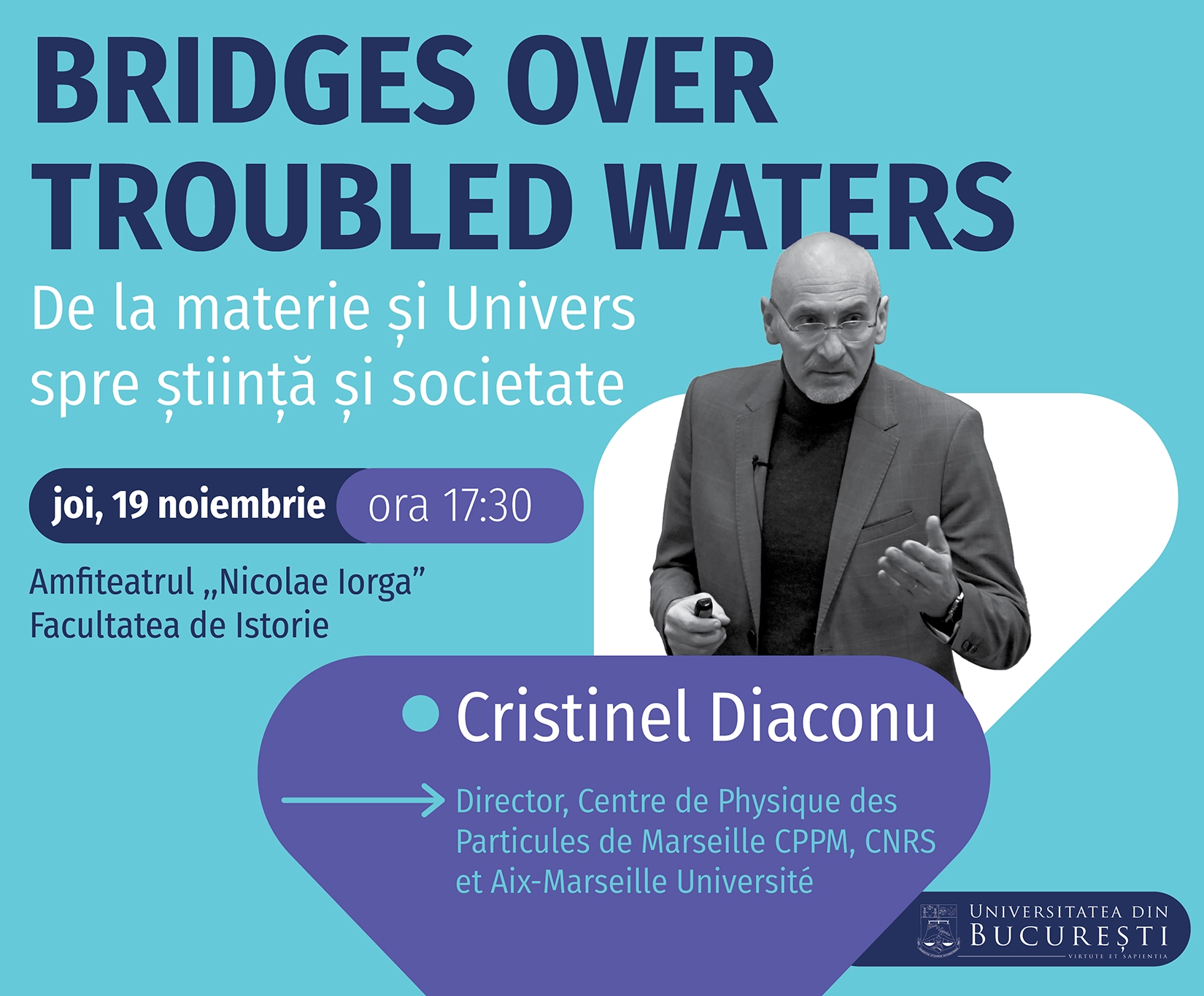
On Tuesday, November 19th 2026, starting 5.30 PM, the University of Bucharest will organize a conference titled “Bridges over troubled waters – from matter and universe to science and society”, delivered by physicist Cristinel Diaconu Director of the Centre for Particle Physics at the French National Centre for Scientific Research (CNRS) and Aix-Marseille University. The event will take place in the “Nicolae Iorga” Amphitheatre of the UB faculty of History (no. 4-12 Regina Elisabeta Boulevard ) and is open to a broad audience interested in science, the big questions about the Universe, and the role of research in contemporary society.
Attendance is free of charge, subject to availability, and requires prior registration here. The event is open to the general public.
Starting from fundamental questions about the nature of matter and time, the fundamental forces, and the origins of the Universe, the conference offers a broader perspective on how scientific knowledge is being built today. Beyond the boundaries of a single laboratory or country, major research projects require complex infrastructure and international collaborations bringing together thousands of researchers.
In this context, Cristinel Diaconu will discuss how scientific partnerships can sometimes overcome political, religious, and economic tensions, building bridges between societies and cultures. In a world where multilateralism is becoming increasingly fragile, scientific cooperation demonstrates its relevance not only through research outcomes but also through its ability to educate new generations of researchers with a global outlook, equipped to understand contemporary challenges and contribute to building a more open, cohesive, and peaceful future.
About the guest
Cristinel Diaconu graduated from the Faculty of Physics at the University of Bucharest, specializing in Theoretical Physics, and holds a master’s degree in Particle Physics, Mathematical Physics and Modelling, obtained in Marseille. He continued his academic career with a PhD in Particle Physics, working on the Large Electron–Positron Collider (LEP) experiment at the European Organization for Nuclear Research (CERN) in Geneva, Switzerland. He subsequently conducted research at Deutsches Elektronen-Synchrotron (DESY) in Hamburg and Zeuthen, Germany, where he coordinated the international H1 experiment between 2008 and 2012.
He later joined the ATLAS collaboration at CERN, one of the world’s most important international scientific research initiatives. Since 2017, he has headed the Centre for Particle Physics in Marseille, coordinating fundamental research activities and major international collaborations.
He is also involved in high-level European committees, contributing to the definition of priorities and development strategies for fundamental research. In 2025, he took part in the foresight exercise on the future of particle physics in Europe and contributed to the strategic discussions within the framework of the European Strategy for Particle Physics (ESPP).
Postări asemănătoare:
 The University of Bucharest launches the “Science on the open stage” lecture series. The first guest, Professor Carmen Chifiriuc, PhD, invites the public on a journey into the universe of the microbiome
 The University of Bucharest launches the “Science on the open stage” lecture series. The first guest, Professor Carmen Chifiriuc, PhD, invites the public on a journey into the universe of the microbiome
 UB Rector, professor Marian Preda, in dialogue with the UNMB and UNATC Rectors at the debate “University, society, creativity”. The event is a special edition of the Conferences of Bucharest National Opera
