

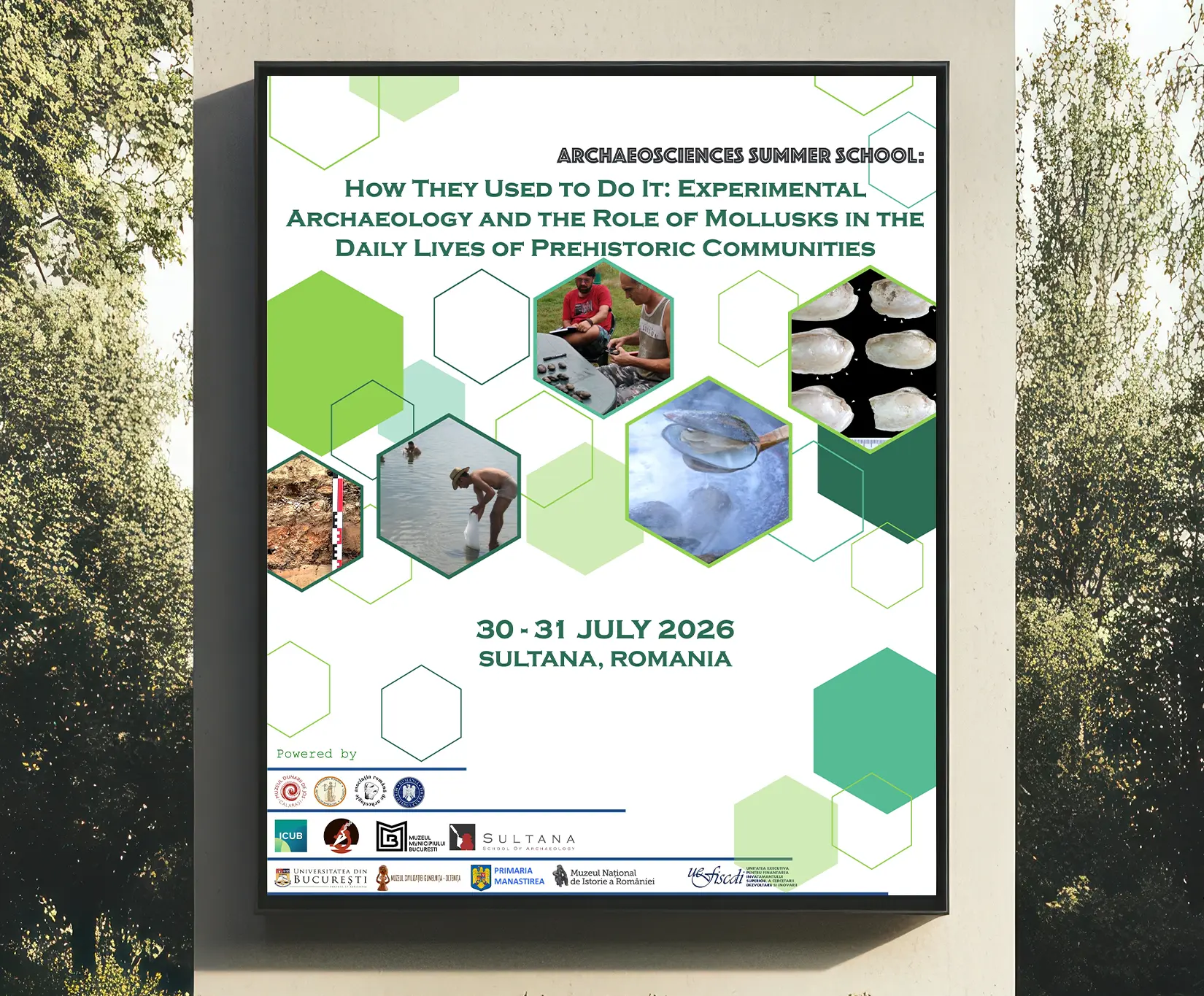
On July 30-31, 2026, the 9th edition of the ArchaeoSciences Summer School, entitled “Arheologie și Moluște”, will take place within the Sultana-Malul Roșu archaeological site (Călărași County, Romania).
The event will be organized by the ArchaeoSciences Platform (ASp) of the Research Institute of the University of Bucharest (ICUB), as part of the interdisciplinary research project First North Pontic Steppe Populations in the Balkans. A bioarchaeological outlook of Cernavodă I communities in the Lower Danube Basin (Romania), no. 77PCE/2025, code PN-IV-P1-PCE-2023-1899.
The event, conducted within the framework of the “Sultana Archaeology School” initiative, are primarily dedicated to students involved in archaeological activities at the site.
Program Highlights
- zooarchaeological methodology and hands-on workshops with faunal remains
- mollusks and ceramics; experimental reconstruction of the Chaîne Opératoire for manufacturing shell-tempered pottery vessels
- experimental use of mollusks as raw material for tool production (blades, scrapers, smoothers, containers) and use-wear analysis through optical microscopy and reference material.
The event is coordinated by Dr. Habil. Valentin Radu, PhD candidate Bogdan Radu Manea, PhD candidate Sebastian Valeriu Dumitrescu, and Dr. Cătălin Lazăr (University of Bucharest, ISDS Bucharest).
Full Program Schedule
Thursday, July 30, 2026, 10:00–11:00
Segment I: “From Shell to Pot: Reconstructing the Chaîne Opératoire of Shell-Tempered Pottery Production”
Coordinator: Bogdan Manea (PhD Candidate, Doctoral School of Interdisciplinary Studies – University of Bucharest, ISDS-UB)
This experimental module reconstructs the complete technological sequence (chaîne opératoire) involved in the manufacture of Cernavodă I shell-tempered pottery, with particular emphasis on the processing and incorporation of crushed shell valves into the clay paste.
Experimental activities will include the procurement and selection of suitable clay and freshwater mollusks shells; shell crushing using different techniques and tool types (stone, bone, antler, wooden, and other experimental implements); comparison of shell fragmentation methods and resulting temper characteristics; preparation of ceramic pastes with different shell recipes and temper proportions; vessel shaping, drying and firing and surface finishing.
By comparing experimental and archaeological shell breakage patterns, documenting the behaviour of crushed shell temper throughout manufacture (vessel forming, drying, and firing), and evaluating its advantages and limitations, we aim to improve our understanding of prehistoric technological choices and production traditions.
Friday, July 31, 2026, 10:00–11:00
Segment II: “More than a Food Source: Experimental Use of Freshwater Bivalve Valves as Versatile Cutting, Smoothing, and Scraping Tools”
Coordinator: Sebastian Dumitrescu (PhD Candidate, Doctoral School of Interdisciplinary Studies – University of Bucharest, ISDS-UB)
Within this workshop, students will explore the experimental and interdisciplinary study of shell blades—sharp-edged bivalve valves used as cutting, scraping, and smoothing tools in prehistoric contexts. By working with modern specimens on different materials, participants will examine wear formation by linking specific gestures, worked materials, and shell physical properties (thickness, curvature, edge-angle) to the resulting use-traces and micro-morphology. Moving beyond traditional use-wear analyses, this approach engages students with the biomechanical aspects of tool use to better understand prehistoric technological choices and the complexity of past human activity.
Experimental activities may include pottery smoothing, processing of organic materials (plant, wood, meat, fish), pigment preparation, and the use of shells as containers. Additionally, participants will have firsthand experience with the unique challenges posed by the fragile nature of shell artefacts, including distinguishing anthropogenic wear from natural post-depositional modifications. Resulting data will subsequently form the basis of a post-workshop archaeometric study involving SEM-EDS and optical microscopy analysis to reveal micro-striations and sub-structure deformation.
The experiments aim to improve our understanding of the functional diversity of mollusks shells and contribute to more reliable interpretations of shell artefacts recovered from prehistoric archaeological contexts.
The ArchaeoSciences Summer Schools are a recent initiative dedicated to students, Master’s, and PhD candidates, offering applied introductions to interdisciplinary methods of researching the past.