



Starting in September 2025, the Faculty of Geology and Geophysics at the University of Bucharest is hosting two volunteers from Germany, Maya Bloos and Finja Lapeßen. They are participants in the Naturweit international volunteer service, run by the German Commission for UNESCO (Deutsche UNESCO-Kommission) through the Kulturweit initiative, in collaboration with the Romanian National Commission for UNESCO. This service offers young people the opportunity to get involved for one year in educational and cultural activities in member countries of the UNESCO network, contributing to their personal and professional development within an intercultural context. The University of Bucharest has been part of this program through the Faculty of Geology and Geophysics and the Hațeg Country UNESCO International Geopark since 2020.
For six months, Maya and Finja are carrying out their activities at the Faculty of Geology and Geophysics (FGG). Starting in February 2026, they will continue their volunteering at the Hațeg Country UNESCO International Geopark, a structure administered by the University of Bucharest.
Thus, during their time at the FGG, the volunteers have been actively involved in the life of the academic community. They were part of the team that organized, promoted, and presented the faculty’s stand at the European Researchers’ Night event, held within the ReCoNnect III project, in which the University of Bucharest is a partner. Their main activity focused on the digitalization of historical materials in the Faculty Library, contributing to the preservation of documentary heritage and the creation of a scientific resource base accessible to researchers and students.
Furthermore, Maya and Finja were involved in organizing the University of Bucharest’s Annual Research Results Communication Conference, contributing to the panel dedicated to UNESCO Geoparks—an interdisciplinary framework for presenting and debating research regarding geological heritage, conservation, education, and sustainable development. At the same time, they supported the arrangement of the Stone Made Objects exhibition, realized in collaboration with the Hațeg Country Geopark, which highlighted the connections between geology, art, and local crafts.
“At Researchers’ Night, I prepared and coordinated activities for children, and I was moved by their joy when discovering science through play; at the conference on Geoparks, I participated actively in discussions, and I was inspired by the spirit of collaboration among specialists,” explained Finja.
Throughout their collaboration with PhD candidate Cristina Toma, the volunteers’ coordinator within the Naturweit program, Maya and Finja deepened their understanding of the role of UNESCO geoparks in supporting sustainable development and how the protection of geological heritage of international value can be leveraged through interpretation, scientific communication, and inter-institutional partnerships. The activities highlighted the importance of geoparks as laboratories for education, research, and community innovation, where science becomes an active tool for local development and civic engagement.
“We wanted the volunteering experience at the Faculty of Geology and Geophysics of the University of Bucharest to exceed the traditional limits of this type of activity and offer a profound formative dimension. Thus, together with Florina Țuluca, we designed a set of activities aiming to increase the knowledge level of volunteers who choose to undertake internships at the Faculty of Geology and Geophysics by exposing them to real geological and geophysical experiences relevant to understanding and protecting natural and cultural heritage,” stated Cristina Toma.
“This year’s Naturweit volunteers are participating in a set of pilot activities through which we wish to enrich the educational experience that the Faculty of Geology and Geophysics can offer for volunteer programs. We believe this approach aligns with UNESCO values, as it promotes interdisciplinary education, youth engagement, and the development of useful skills in preserving heritage sites vulnerable to natural and anthropogenic hazards,” declared Florina Țuluca.
In this regard, the volunteers participated in one of the “Urban Geophysics” activities, developed by Lecturer Dr. Eng. Florina Țuluca in a collaboration involving SGAR (Romanian Society of Applied Geophysics), the Faculty of Geology and Geophysics, and industry partners. These activities aim to perform geophysical measurements in vulnerable areas of Bucharest and form an interdisciplinary perspective on how geophysical methods can contribute to solving societal problems.
For the demonstration action carried out at the heritage building founded in 1746 by Smaranda Mavrocordat, the wife of ruler Nicolae Alexandru Mavrocordat, a multidisciplinary group was constituted, consisting of participants from Germany, Algeria (Matougui Zakaria – researcher affiliated with the Centre de Recherche en Aménagement du Territoire – CRAT), and Romania (Daniela Ghica – researcher at INFP, and representatives of the establishment).
In addition to the demonstration of electromagnetic induction measurements, carried out both outside and inside the building, the activity included a presentation of the history and constructive particularities of the property, the identification of structural vulnerability elements of the building, and their correlation with hazards (seismic, climatic, or anthropogenic) that have affected and may continue to affect the building’s condition. Moreover, the geophysical data obtained during this workshop will be processed and integrated into educational materials subsequently used in the Master’s course Electromagnetic Methods in Geophysics, within the English-taught program Applied Geophysics at the Faculty of Geology and Geophysics.
“It was fascinating to discover that geophysics is not just a theoretical field but has essential practical applications, for example, in the restoration of heritage buildings. The fact that we could see directly how measurements are taken, and understood the reasons behind them and their utility, made a subject that otherwise would have seemed rather complicated become accessible and interesting,” declared Finja.
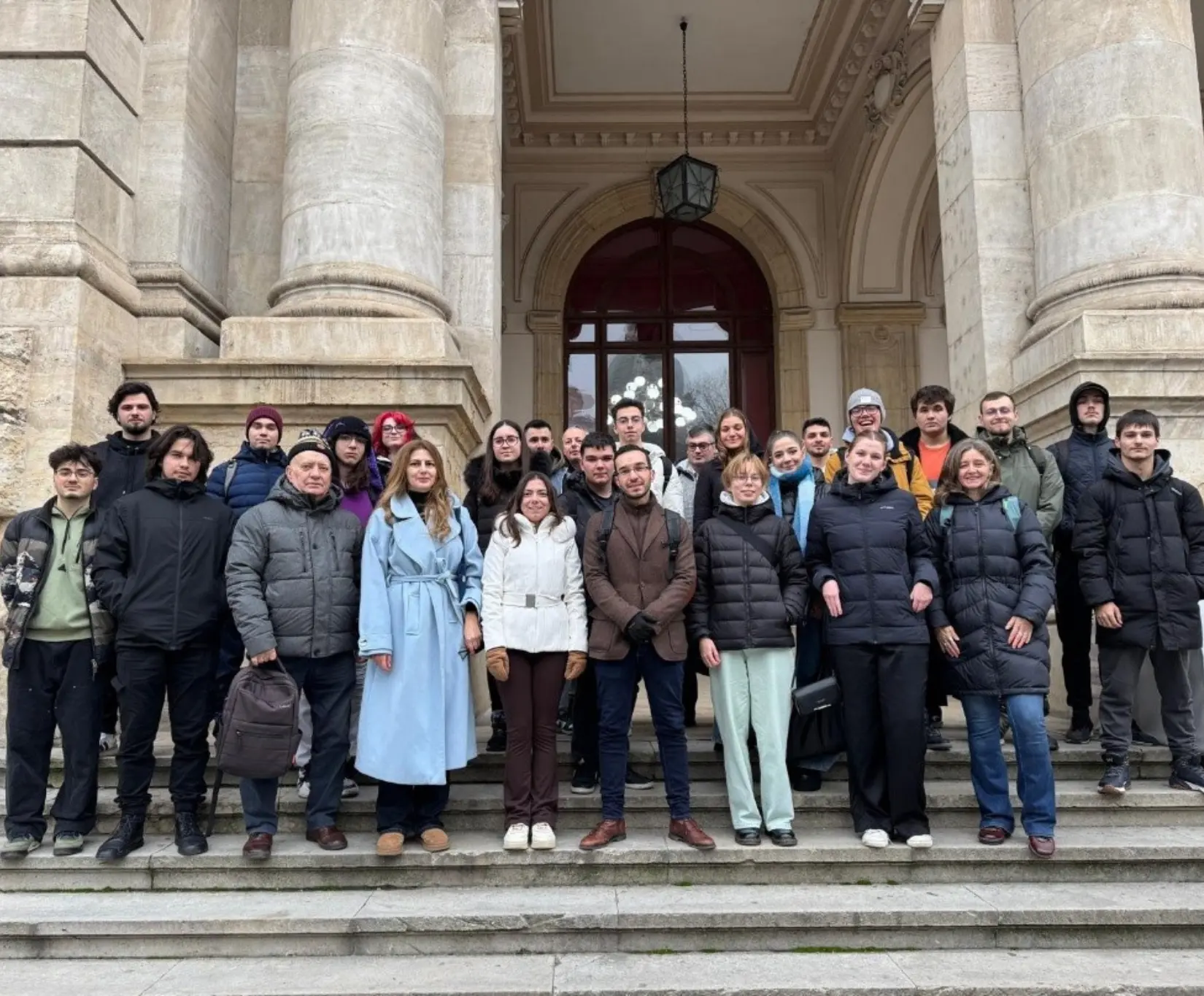
Following these experiences, the Naturweit volunteers joined the 4th-year Geophysics students during the laboratory activity of the Electrical Prospecting course to assist in a “geophysical tour” of emblematic buildings in central Bucharest. The activity aims to correlate geoelectrical data with the state of conservation, structural vulnerabilities, and hazard factors affecting built heritage, contributing to the development of an applied perspective on the conservation and safety of historical buildings.
“I liked the tour very much and considered it particularly interesting because I had the opportunity to learn about the buildings, their problems, and the causes of their deterioration directly from specialists; the experience offered me not only a new perspective but also a deeper understanding of the phenomena affecting built heritage. I also enjoyed preparing a micro-presentation on my own about the history of a heritage building of great importance—the National History Museum—and sharing the information with the participating students,” Finja further noted.
“It was a captivating experience to be able to learn about the city and see the problems that earthquakes can cause even in more distant regions,” added Maya Bloos.
The “geophysical tour of emblematic buildings in Bucharest” is part of an urban lesson concept developed by Lecturer Dr. Eng. Florina Țuluca in collaboration with Lecturer Dr. Andreea Andra-Topârceanu (Faculty of Geography, University of Bucharest), using both data from the GeoAlliance project (2024/395080 EEA and Norway Grants: Driving Sustainable Urban Futures: A Romanian-Norwegian Innovation Geophysical Alliance for Green Transition and SMART City Development) and archive data. This concept integrates geophysical and geomorphological data at the level of Bucharest city, offering students a complex educational experience where theoretical elements are correlated with direct field observations.
“It was a distinct pleasure to host the Naturweit volunteers during classes and extracurricular activities, and their presence represented a valuable experience for me. I wanted their experience in the activities I designed together with Cristina and Andra not to be a passive one, limited to the role of an audience, but to involve active engagement. In this sense, we introduced into the program a micro-presentation given by Finja in front of the students, demonstrating that volunteers participating in activities at the University of Bucharest can play an active and relevant role within extracurricular educational initiatives. I strongly believe that exposing volunteers to these geophysical technologies can contribute significantly to their training and preparation to support conservation efforts or, in critical situations, to save structures in the path of hazards. Within UNESCO initiatives, we are all—scientists, teachers, and volunteers—a united team for heritage protection,” declared Florina Țuluca.
Another stage of the pilot program for volunteers undertaking internships at the Faculty of Geology and Geophysics consists of their involvement in the vulnerability analysis of UNESCO sites in Romania, using the database of the project UB Research Project (10101/ 2024), SPAH – Sustainable Participatory Activities for Heritage for Conscious Communities, led by Dr. Andreea Andra-Topârceanu.
The participation of volunteers in such actions has significant formative value: direct contact with geophysical methodologies, real case studies, and heritage conservation issues can stimulate the development of innovative ideas that may find applicability in vulnerable UNESCO heritage sites. In these contexts, geophysical methods can support the identification of solutions to reduce the impact of hazards, contributing to the protection and enhancement of cultural heritage.
The program developed this year for volunteers undertaking internships at the Faculty of Geology and Geophysics reflects not only the commitment to promote international cooperation, education for sustainable development, and the valorization of geological and cultural heritage but also the ambition to transform the Faculty into a regional hub for training volunteers dedicated to geoparks.
Postări asemănătoare:
 Prof. eng. Mihai Emilian Popa, PhD. Director of the Doctoral School of Geology of the Faculty of Geology and Geophysics of the University of Bucharest, DHC of the University of Petroșani
 About dinosaurs and their world with Zoltán Csiki-Sava, PhD, from the Faculty of Geology and Geophysics of the University of Bucharest
 About innovative solutions for the management of solid municipal waste deposits, with Florina Țuluca, lecturer at the Faculty of Geology and Geophysics of the University of Bucharest
 The Faculty of Geology and Geophysics of the University of Bucharest, part of the project RO-GEO4HUMANITY
