




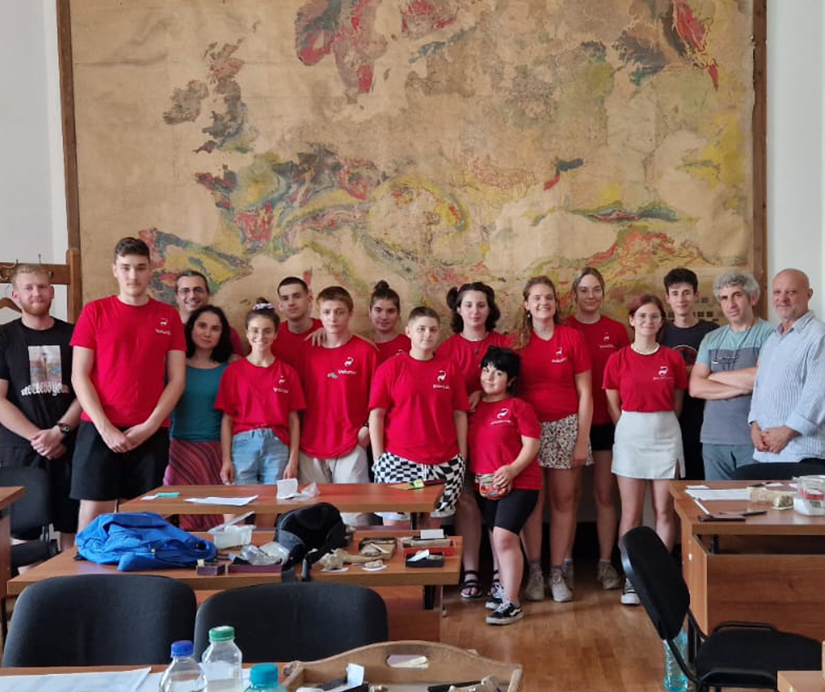
In July 2023, the volunteers of the UNESCO International Geopark Ţara Hațegului contributed, for four days, to the inventory of the paleontology collection at the Faculty of Geology and Geophysics (FGG) of the University of Bucharest.
It is the first time that representatives of the local community in Ţara Hațegului came into contact with this valuable collection that made the area known in the scientific milieu.
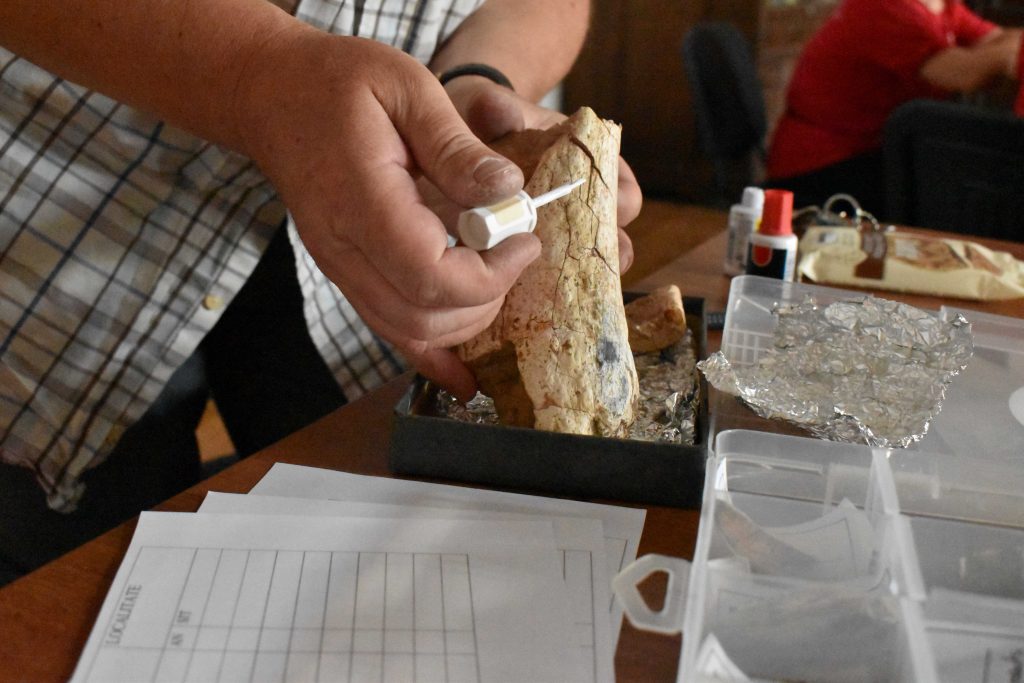
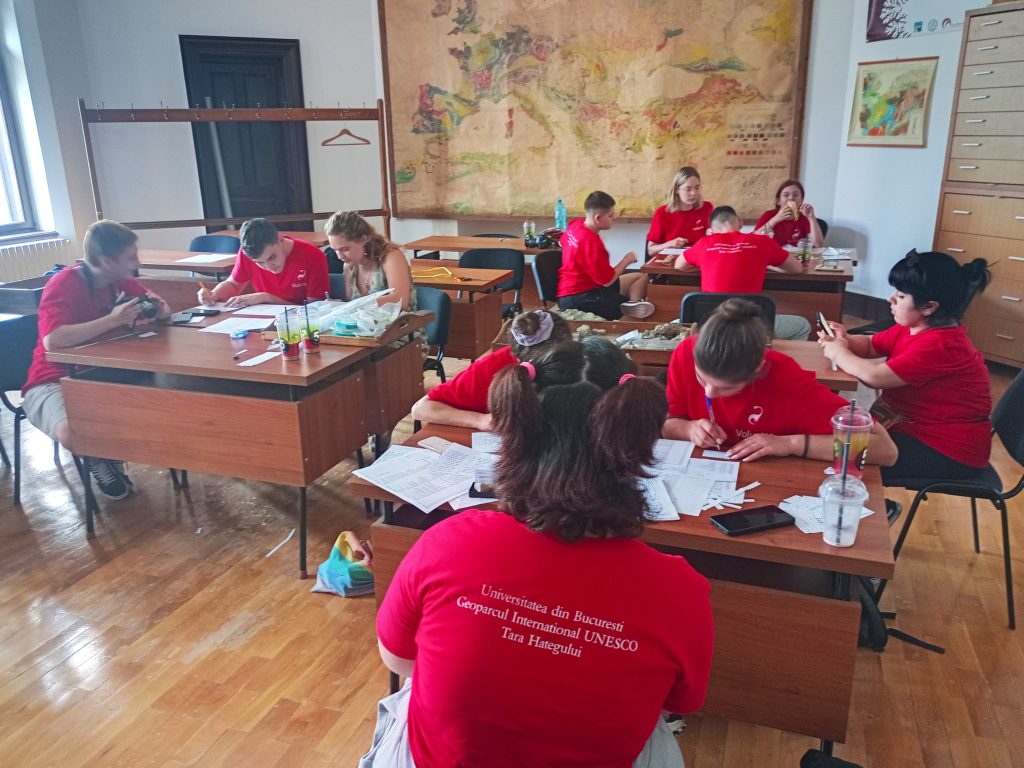
During the four days, more than 500 samples passed through the hands of the volunteers, most fossils of the dinosaurs Zalmoxes robustus, Telmatosaurus transsylvanicus, Magyarosaurus dacus and turtle Kallokibotion bajazidi. Each piece in the collection was checked by inventory number and compared to the collection list. Each fossil was then given a new label and photographed.
Assoc. prof. Zoltán Csiki – Sava, PhD, teaching staff at the Faculty of Geology and Geophysics of the University of Bucharest, and the local coordinator of the International UNESCO Geopark Ţara Haţegului, Cristian Ciobanu, PhD, guided thirteen volunteers, nine of whom are from Ţara Hațegului and Constanța. They were joined by three Naturweit volunteers from Germany, who are doing an internship in the UNESCO International Geopark Ţara Hațegului, facilitated by the National Commission of Romania for UNESCO. Together with the volunteers from Romania and Germany, two students from the Faculty of Geology and Geophysics also participated.
“In the paleontology laboratory of the Faculty we have an important collection of fossils from the Cretaceous and, most importantly, fossils that were discovered over the years in Ţara Haţegului, on the current territory of the Geopark. They are fossils that are the basis of scientific research and that help us to reconstruct Cretaceous life, on the former island of Hațeg. It represents part of the geological heritage of the Geopark, and we thought that young people in the area might be interested in discovering it firsthand by participating in an inventory action. We didn’t limit ourselves only to work, but also to discussions through which I tried to answer as many questions as possible related to the dwarf dinosaurs in Ţara Haţegului and to the field work of paleontologists”, says prof. Zoltán Csiki – Sava, PhD.“It was a painstaking activity because we had to handle the fossils with great care”.
A beautiful experience, considering that we were able to touch the fossils of living things from 70 million years ago. Probably, only paleontologists had done it before us. I’m still surprised that I inventoried a lot of fossils discovered only in Ţara Hategului. There are others, also from our area, which are still waiting to be researched by scientists”, says Răzvan Crețu, one of the youngest volunteers of the UNESCO International Geopark Ţara Haţegului.
On this occasion, the volunteers learned, in addition to information related to the inventory, what the work of a paleontologist means, how fossils are discovered and what actions must be taken to protect them. It was also an opportunity to understand the importance and value of a scientific collection accessible to paleontologists everywhere and why it must be kept safe by specialist curators.More information on the activities carried out by the UNESCO International Geopark Ţara Haţegului can be accessed here and here.

SECŢIUNE ACCESIBILIZATĂ PENTRU PERSOANELE CU DIZABILITĂŢI DE VEDERE
Postări asemănătoare:
 A new species of fossil turtle, discovered on the territory of the UNESCO International Geopark Țara Hațegului of the University of Bucharest
 The Hațegului Geopark and the Buzăului Geopark, Managed by UB, Celebrate Intangible Cultural Heritage
 Three Villages in Hunedoara Country on the Territory of the UNESCO International Geopark Ţara Hațegului, managed by the University of Bucharest, Will Host Award-Winning Theater Performances this Year at the UNITER Gala
 The Țara Hațegului Geopark, managed by the University of Bucharest, was an example of cooperation between the local community and the academic milieu
