



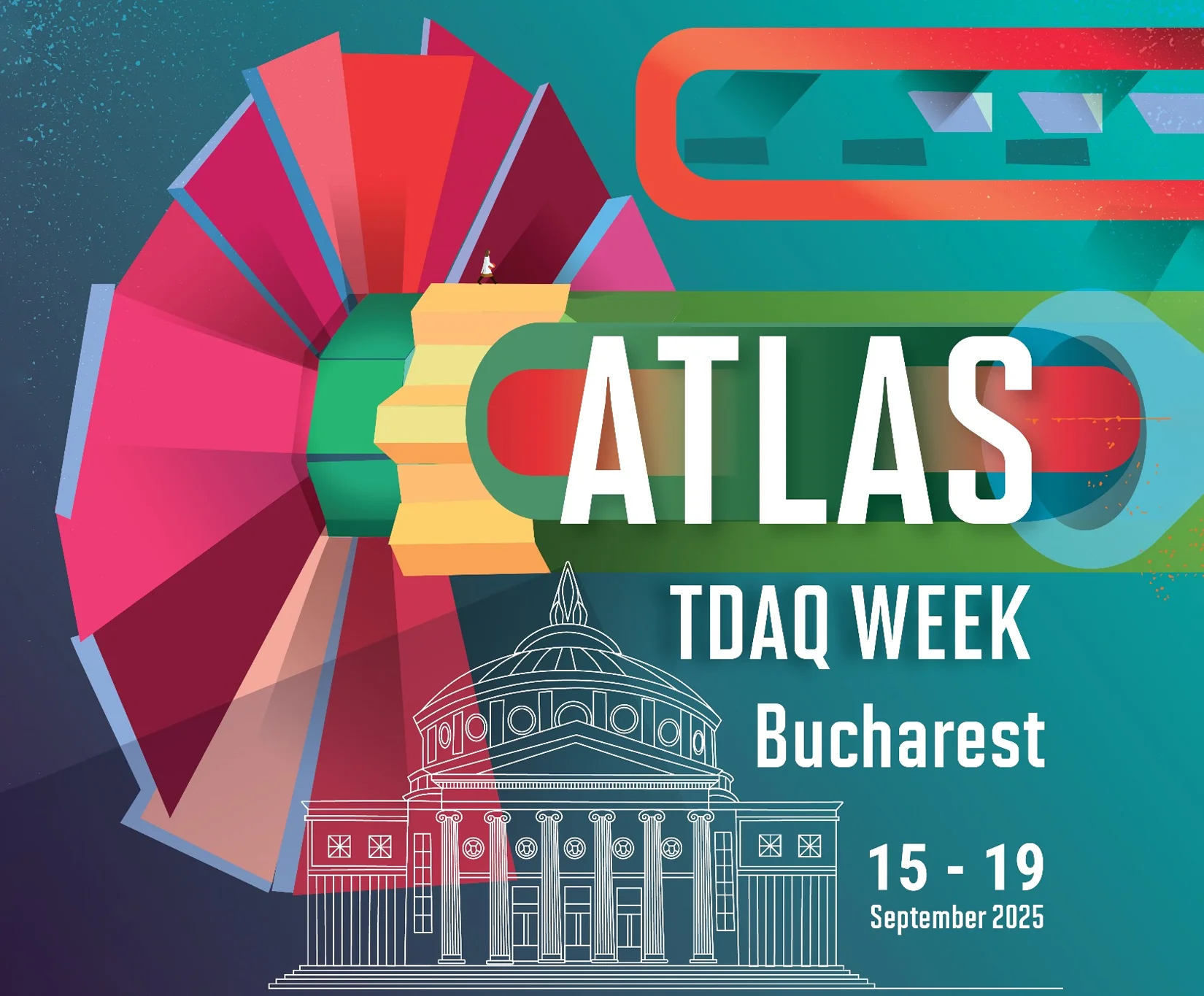
Between 15 – 19 September 2025, the University of Bucharest will host the TDAQ (Trigger and Data Acquistion) week of the ATLAS experiment at CERN, a major event for the international scientific community.
The event will take place in the Rectorate building of the University of Bucharest and will bring together physicists and engineers from more than 40 countires. The local coordinators are CS I Dr. Călin Alexa from the National Institute for Nuclear Physics and Engineering ”Horia Hulubei” (IFIN – HH) and associate lecturer at UB, and Lect. Roxana Zus, PhD, teaching staff at the Faculty of Physics, University of Bucharest, and Romania’s designated representative in the CERN Teaching and Student Forum.
The official opening will take place on Monday, September 15th, at 10:00 AM, with welcome remarks from Prof. Marian Preda, PhD, Rector of the University of Bucharest, and Prof. Carmen Chifiriuc, PhD, Vice-Rector for Research.
TDAQ Week is a working conference of key importance for the ATLAS experiment, one of the largest and most complex particle physics projects carried out at CERN’s Large Hadron Collider (LHC).
The main scientific goal is to ensure that the TDAQ system operates at peak performance. Participants will discuss how to improve data acquisition rates, reduce errors, and adapt to the constantly evolving conditions of the LHC. High-energy physics is not only about scientific discovery but also about technological innovation. During TDAQ Week, new technologies in electronics, software, and distributed computing are presented and debated – technologies that are vital for the upcoming upgrades of the experiment.
The meeting also provides an opportunity for young researchers and engineers to learn from experts and become integrated into the collaboration. It is a platform for knowledge transfer, in-depth discussion of technical challenges, and building professional networks.
The week’s program is wide-ranging, covering topics from the current status of the TDAQ system and modernization plans to specialized sessions on software, hardware, and monitoring systems. Over five days, the agenda will feature plenary sessions, technical presentations, working group meetings, and events dedicated to early-career researchers – an ideal setting for exchanging ideas, fostering collaboration, and driving innovation.
Romania plays a significant role in the development of the TDAQ system through the national ATLAS cluster, which brings together five universities and two national research institutions. Romanian teams have been deeply involved in the upgrade of the ATLAS detector, contributing to the design and implementation of key components such as the trigger processor for the New Small Wheel (NSW) detector and the FELIX (Front-End Link eXchange) technology. These contributions highlight the high-level expertise of Romanian researchers and strengthen the country’s status in the international scientific community.
By participating in TDAQ, Romania takes an active role in global scientific infrastructure. Work on TDAQ requires a unique combination of expertise in particle physics, electronic engineering, and high-performance computing.
The Romanian ATLAS cluster provides valuable expertise across all these areas. Each improvement made by the Romanian teams increases the chances of achieving new breakthroughs in fundamental physics. Direct involvement in developing and operating critical systems such as TDAQ consolidates Romania’s position in the international scientific arena and demonstrates its capacity to contribute to large-scale global projects.
The organizing team also includes researchers from UB and IFIN -HH within the ATLAS/ CERN Romania group led by Dr. Călin Alexa, with the support of ”SciResCareer – Regional Center for Career Guidance and Counseling in Research – Bucharst – Ilfov – from pre-university education to advanced research.”
SECŢIUNE ACCESIBILIZATĂ PENTRU PERSOANELE CU DIZABILITĂŢI DE VEDERE
Postări asemănătoare:
 A university for the future generations! November 4th – 9th 2024, Sustainability Week at the University of Bucharest
 The 2021 edition of Local CIVIS Days Bucharest reached its final after a week full of conferences, competitions and activities dedicated to the university community
A university for the future generations! November 4th – 9th 2024, Sustainability Week at the University of Bucharest
The 2021 edition of Local CIVIS Days Bucharest reached its final after a week full of conferences, competitions and activities dedicated to the university community
A university for the future generations! November 4th – 9th 2024, Sustainability Week at the University of Bucharest
