




We are increasingly aware that health is not solely a matter of biology and medicine. There are numerous social determinants of health, which is profoundly influenced by culture, by the way people understand reality, and by how they relate to the context in which they find themselves.
Starting from this idea, we invited sociologist Marius Wamsiedel, a faculty member at the Faculty of Sociology and Social Work at the University of Bucharest, to discuss how sociology can help us understand, in a complex, comprehensive, and contextualized manner, the behaviors related to health and the ways in which people act either to prevent or to manage chronic medical conditions such as hypertension and diabetes.
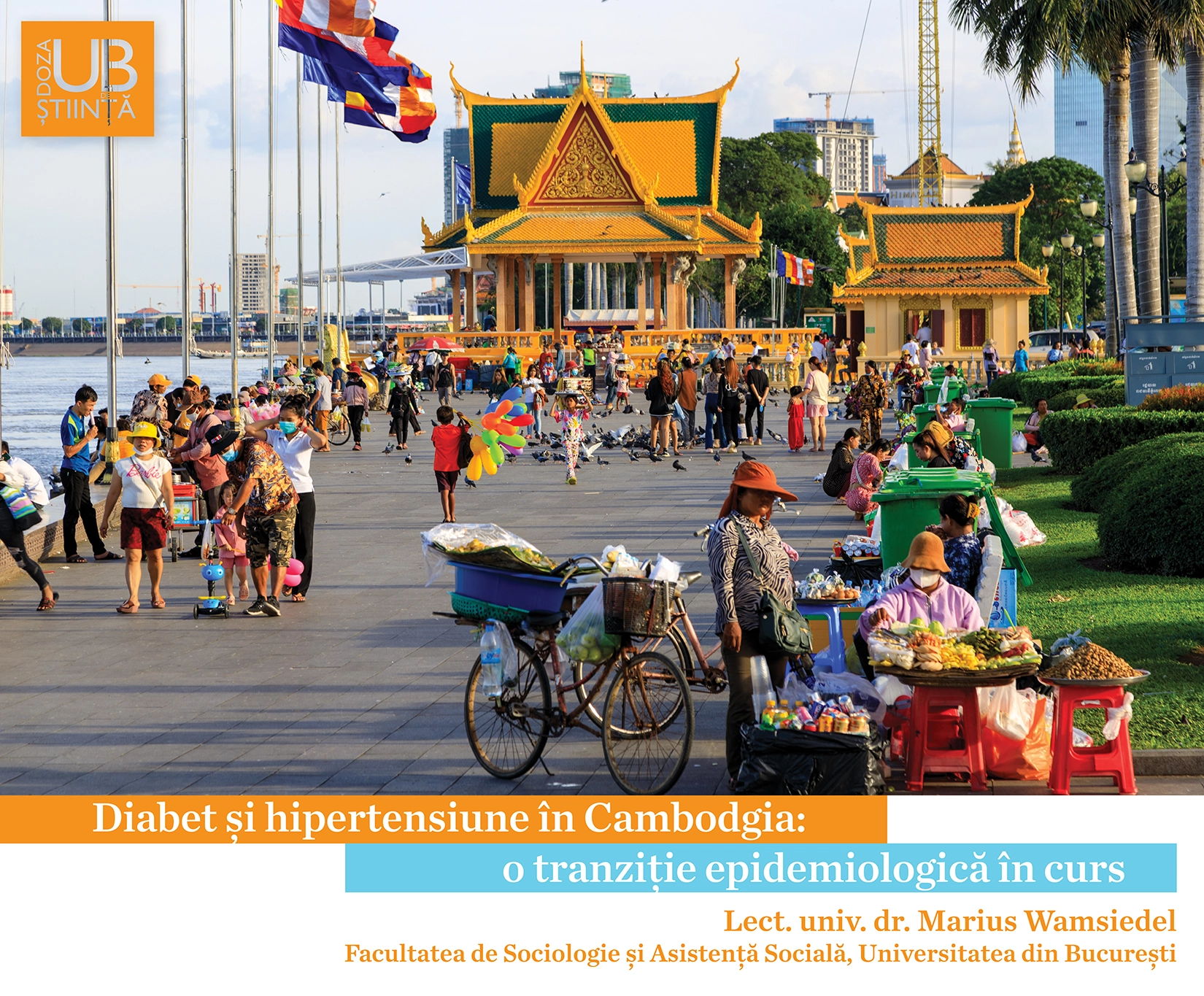
Episode number 22 of the UB Dose of Science series, “Diabetes and Hypertension in Cambodia: An Ongoing Epidemiological Transition”, featuring Marius Wamsiedel, can be accessed with just one click below.
As Marius Wamsiedel explains, nearly nine years of teaching global health at institutions abroad led him to discover, beyond a theoretical perspective on sociology, the importance of applied sociological research — the way sociological knowledge and methods can contribute to building a better society.
Conducted in 2023 in Cambodia, within a partnership between Duke Kunshan University in China, where Marius Wamsiedel was working at the time, and the University of Health Sciences in Phnom Penh, Cambodia, the research that forms the subject of this edition of the UB Dose of Science was an interdisciplinary endeavor. Drawing on a multifaceted team composed of a sociologist, a physician, and two epidemiologists, the study addressed a major public health issue: the rapid increase in the prevalence of chronic diseases. As our guest points out, this phenomenon is not specific to Cambodia alone — it is a global phenomenon, marking a genuine process of epidemiological transition. As a society develops economically, medicine also becomes more advanced, and people’s lifestyles change. Gradually, infectious diseases are replaced by chronic diseases as the primary cause of morbidity and mortality. This has occurred in all developed societies. On the other hand, Marius Wamsiedel explains, the situation becomes more complex in developing societies such as Cambodia, which is in the midst of an epidemiological transition — meaning the transition has not yet fully taken place. These countries face infectious diseases and chronic diseases simultaneously, placing enormous pressure on the healthcare system, significantly increasing costs, and requiring differentiated management.
In this context, the research team of which Marius Wamsiedel was a part set out to investigate and understand how people manage the symptoms associated with common chronic conditions such as diabetes and hypertension. Since epidemiological studies have shown that approximately 45% of people living with diabetes in Cambodia have not received a diagnosis, the research targeted not only individuals who had already been diagnosed with these conditions, but also people who were unaware they were suffering from them.
As Marius Wamsiedel explains, regarding the research framework and the way Cambodian reality shapes people’s relationship with these chronic diseases, two elements are critically important. The first is medical pluralism, which refers to the coexistence within the same society of multiple healthcare systems: on one hand, modern Western medicine, and on the other, traditional Khmer medicine, practiced for millennia and held in very high regard. In recent years, alternative or complementary medicine has also begun to emerge, particularly in urban areas. A second important contextual element concerns Cambodia’s adoption of two social health protection measures. One of these forms of health insurance targets people in economically vulnerable situations, while the second provides services to individuals employed in the formal economy — initially extended to those in the public sector and gradually expanded to those in the private sector as well.
More about this research endeavor, the findings of the research team, self-medication, changes in dietary habits, the use of natural remedies and traditional healers, the encounter between modern and traditional medicine, as well as the importance of sociology and interdisciplinary approaches in understanding global health challenges — all of this is discussed by Marius Wamsiedel in the 22nd episode of the UB Dose of Science series.
Marius Wamsiedel is a lecturer at the Faculty of Sociology and Social Work of the University of Bucharest and an associate lecturer in public health at Duke Kunshan University. His articles have been published in Sociology of Health & Illness, Social Science & Medicine, Time & Society, BMC Public Health, and BMC Geriatrics. In 2023 he published the monograph The Moral Evaluation of Emergency Department Patients: An Ethnography of Triage Work in Romania (Lexington Books). He is currently researching informal payments for healthcare services in Romania and learning cultures in transnational universities.
UB Dose of Science proposes a concise and dynamic way of communicating scientific information in an engaging, lively, and expressive format, establishing a platform for dialogue with the general public interested in science and encouraging connection between academic and non-academic environments around current and relevant topics.
The guests of this series — designed to offer a synthetic and captivating means of communicating across various fields of science — are primarily professors and researchers from the academic community of the University of Bucharest.
The materials within the UB Dose of Science series include short, dynamic presentations of topics relevant to contemporary society: pollution, climate change, education, digitalization, significant research contributions, and more. Thus, alongside the fundamental dimension of communicating scientifically validated information, the Dose also offers an important component of social responsibility, reaffirming the role and mission of the University of Bucharest within society and contributing to awareness of pressing issues in today’s world and to the popularization of possible solutions to these problems.
The UB Dose of Science series is produced by the Research Institute of the University of Bucharest and the Communication and Public Relations Department of the University of Bucharest.
Postări asemănătoare:
 „Model David Popovici”, about passions, ideals, psychology and social work in a one-of-a-kind interview. The sportsman, student at the UB Faculty of Sociology and Social Work
 „Model David Popovici”, about passions, ideals, psychology and social work in a one-of-a-kind interview. The sportsman, student at the UB Faculty of Sociology and Social Work
 International conference of the Society of Sociologists in Romania “Intersections 2024: Structures and Flows. Exploring Multiplexity in Contemporary Sociology”, organized at the UB Faculty of Sociology and Social Work
 Irina Zamfirescu, a faculty member at the Faculty of Sociology and Social Work at the University of Bucharest, has been appointed as a member of the newly set up Housing Advisory Board of the European Commission
