

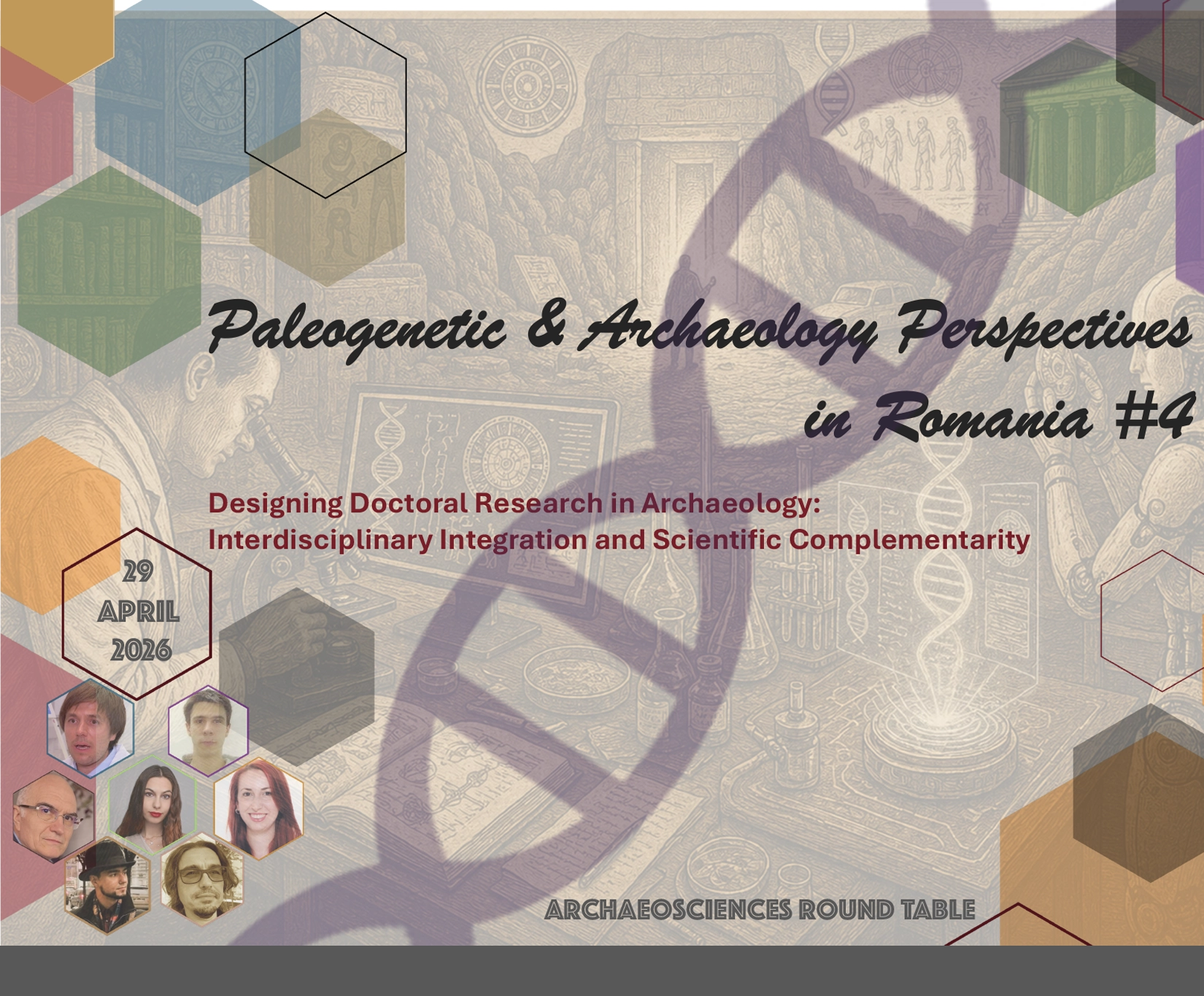
On April 29, 2026, starting at 14:00, the fourth edition of the ArchaeoSciences Round Tables series, titled Paleogenetic & Archaeology Perspectives in Romania, was held at the ArchaeoSciences Platform (ASp) within the Research Institute of the University of Bucharest (ICUB), in collaboration with the Faculty of Biology, University of Bucharest. The event aimed to strengthen interdisciplinary dialogue between archaeology, paleogenetics, and related fields. It took place in the established venue—the seminar room (basement, former herbarium), Botanical Garden building.
This edition was organized as a closed-format meeting, specifically designed to facilitate direct interaction between researchers and a selected group of students, PhD candidates, and prospective doctoral students interested in developing advanced research directions.
The main participants included Mircea Iliescu (University of Cambridge), Ana García-Vázquez, Valentin Radu, and Cătălin Lazăr (ASp–ICUB), who moderated an extended session of applied discussions with master’s and doctoral students. These discussions focused on integrating doctoral research topics within ongoing interdisciplinary research projects.
Particular emphasis was placed on the articulation of doctoral projects complementary to the research conducted at the Sultana and Gumelnița archaeological sites, with focus on:
- defining research topics embedded within existing archaeological projects;
- correlating paleogenetic investigations with other methodological approaches (archaeometry, stable and radiogenic isotope analyses, and studies of material culture—especially ceramics);
- identifying conceptual and methodological frameworks enabling the development of complementary doctoral theses, avoiding thematic overlap while ensuring coherent integration into site-specific research agendas;
- exploring the interdisciplinary potential of these sites within both regional (Lower Danube) and broader European contexts.
A central component of the meeting was the direct dialogue with participants, focusing on the concrete construction of doctoral research topics—from the formulation of research questions to their integration within existing analytical infrastructures and international academic networks.
The event highlighted the importance of a coordinated approach across different subfields of archaeology and archaeosciences, emphasizing the role of the ASp–ICUB platform as a core hub for interdisciplinary research development and advanced academic training in Romania.