




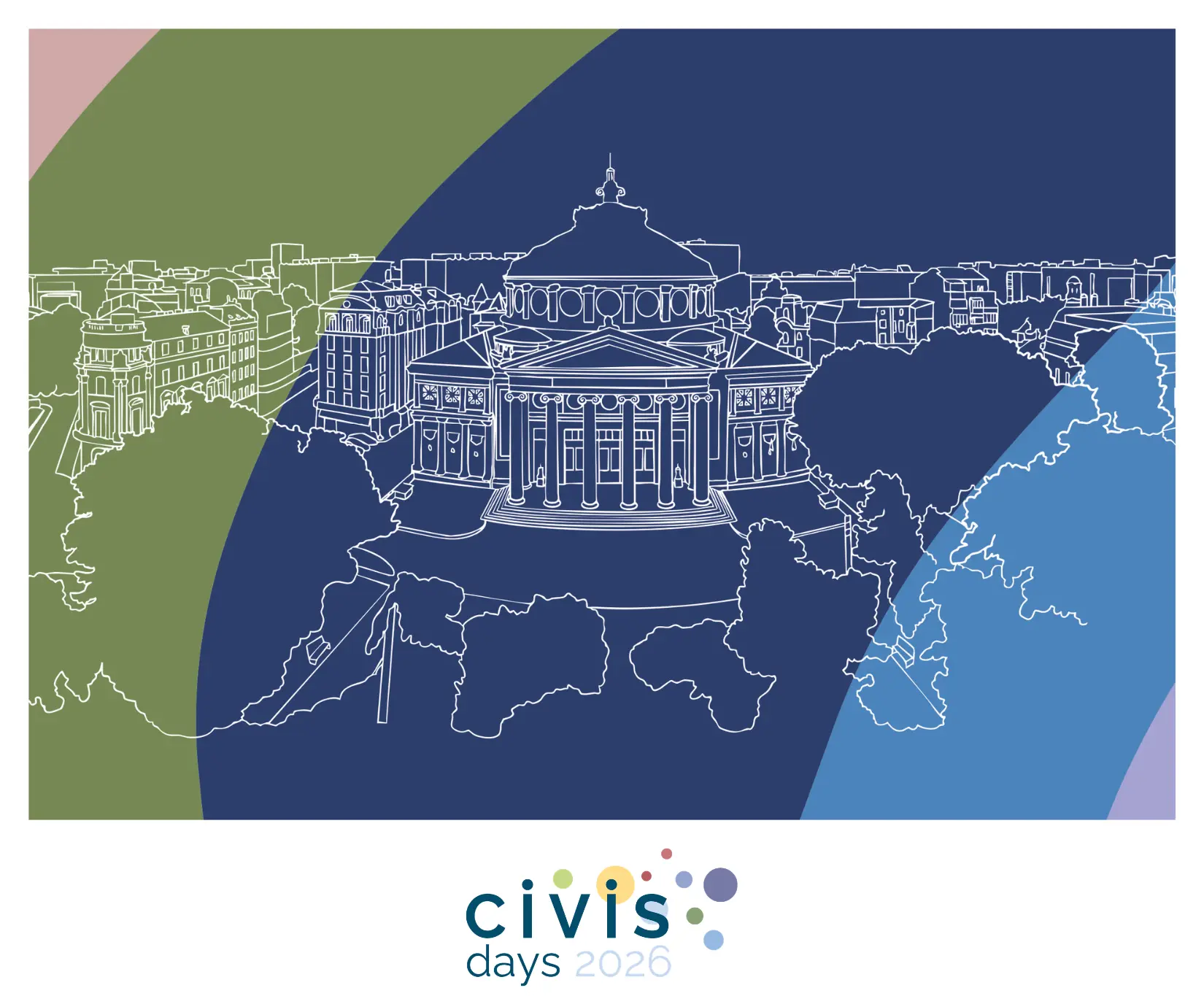
The University of Bucharest will host CIVIS Days 2026, the flagship annual event of CIVIS – Europe’s Civic University Alliance, from June 10 to 12, 2026.
Held under the theme “CIVIS is News – seven years of shared impact,” the event marks seven years of collaboration, innovation, and transformation within the European alliance and aims to provide a space for dialogue, reflection, and inspiration for academic communities and CIVIS partners alike
This year’s theme reflects the alliance’s journey in developing joint initiatives in education, research, academic mobility, inclusion, and civic engagement, further establishing CIVIS as a European laboratory for ideas and transformation.
Over the course of three days, CIVIS Days 2026 will bring together students, faculty members, researchers, and external partners from across the alliance’s member universities for a series of panels and sessions dedicated to the future of European university cooperation.
Sessions Focused on European Education, Mobility, and Collaborative Research
The 2026 edition will feature a range of thematic panels and discussions addressing the key challenges and opportunities facing European university alliances today.
European Alliances, joint learning, new pathways: a CIVIS conversation
June 11, 2026, 09:00 – 10:30
This session will examine how educational projects developed within the CIVIS alliance contribute to creating new models for learning and European academic cooperation. Through initiatives such as TRACEE, NAT4DD, and PolyCIVIS, the discussion will highlight innovation in joint degree development, student experience, and emerging forms of collaboration among European universities.
Speakers will include Alasdair Skelton and Sara Laginder (TRACEE), Gudrun Zagel and Roman Puff (PolyCIVIS), Lavinia Ruta and Daniela de Vita (NAT4DD), Clara Baumgarten, and Francisc Dancu, alongside an invited external guest. The session will be moderated by Alexandru Carțiș.
Mobility Beyond Numbers: aligning Quantity, Quality and Impact
June 11, 2026, 11:00 – 12:30
This panel will address one of the central debates surrounding European university alliances: redefining academic mobility. Discussions will focus on the relationship between physical and virtual mobility, as well as the challenge of balancing quantity, quality, and impact in achieving European mobility goals for students and university staff.
The session will bring together representatives of European university alliances and experts in European education policy, with the full list of speakers to be announced by the organizers.
Open Labs Without Borders: Why Cross-Border Collaboration Matters
June 11, 2026, 13:30 – 15:00
This session will explore how Open Lab projects can address local challenges through international collaboration. Drawing on examples developed within the alliance, participants will discuss the benefits, challenges, and lessons learned from cross-border cooperation and community engagement in European projects.
Invited speakers include Patrick Michel and Wasfi Al Nassef for the project Veris – Voices of Palmyra; Daniel Buhr and Johanna Berglund for the project Ageing as a Journey; as well as Daniele Gorla, who will present the year-round CIVIS Open Lab initiative Music Ensembles. The session will be moderated by Kenneth Skeldon.
Planting the seeds for research collaboration
June 12, 2026, 09:00 – 10:30
This plenary session will showcase research projects developed through CIVIS seed funding calls and examine the role of these initiatives in building long-term academic collaboration across the alliance. Discussions will address both the opportunities and challenges involved in developing interdisciplinary European research networks.
Among the invited speakers are Delia Popescu, Adriana Ștefănel, and Ionela Băluță from the University of Bucharest, alongside Nolwenn Bühler, who will participate online. The session will be moderated by Julie Hyzewicz.
Pathways for Competitiveness: The Role of Alliances in Bringing Skills to All Learners
June 12, 2026, 11:00 – 12:30
This panel will examine the role of university alliances in developing flexible and inclusive educational pathways through micro-programs and micro-credentials tailored to diverse groups of learners. The session will highlight CIVIS initiatives focused on future-oriented skills within the broader context of European priorities related to competitiveness, lifelong learning, and digital transformation.
The panel will be moderated by Nadia Fernandez de Pinedo Echevarria, Alejandra Gamez Abascal, and Ignacio Rodriguez Alvarez. Participants will include Silvia Arias, coordinator of the University Civic Engagement micro-credential, and David Poveda.
Some of the events will also be streamed online.
CIVIS Days is the alliance’s flagship annual event and aims to strengthen collaboration among member universities, promote joint projects, and contribute to the development of a European space of knowledge, solidarity, and inclusion. The previous edition took place in Rome under the theme “Inclusion and Diversity in Higher Education.”
CIVIS – Europe’s Civic University Alliance, one of the first European University Alliances, brings together 11 higher education institutions across Europe: Aix-Marseille Université, National and Kapodistrian University of Athens, University of Bucharest, Université libre de Bruxelles, Universidad Autónoma de Madrid, Sapienza Università di Roma, Stockholm University, Eberhard Karls Universität Tübingen, University of Glasgow, Paris Lodron University of Salzburg, and the University of Lausanne, as well as six African partner institutions: Université Hassan II de Casablanca, Université Cheikh Anta Diop de Dakar, University of the Witwatersrand, Makerere University, Eduardo Mondlane University, and the University of Sfax. Together, the alliance connects more than 470,000 students and over 68,000 members of the academic community, fostering a multilingual and multicultural environment. The network aims to strengthen existing ties in research and education among partner universities through interdisciplinarity, shared research infrastructures, and collaborative funding opportunities.
Postări asemănătoare:
 The Learning Centre of the University of Bucharest, present at the Global CIVIS Days 2024 event with the first study of organizational culture realized within the Alliance
 The University of Bucharest, the host of the 25th annual congress of the European Public Relations Education and Research Association (EUPRERA)
 The University of Bucharest, host of the event “On revolution and democratic change: a debate with Svetlana Tikhanovskaya”
 Representatives of the University of Bucharest and the CIVIS Alliance, on the scene of the most important European event dedicated to the European degree
