

South Asia Experiences and New Perspectives for Romania Invited talk by Professor Niraj Rai: “Unraveling the past through ancient DNA and stable isotope analysis: Emerging frontiers in Archaeological Sciences”
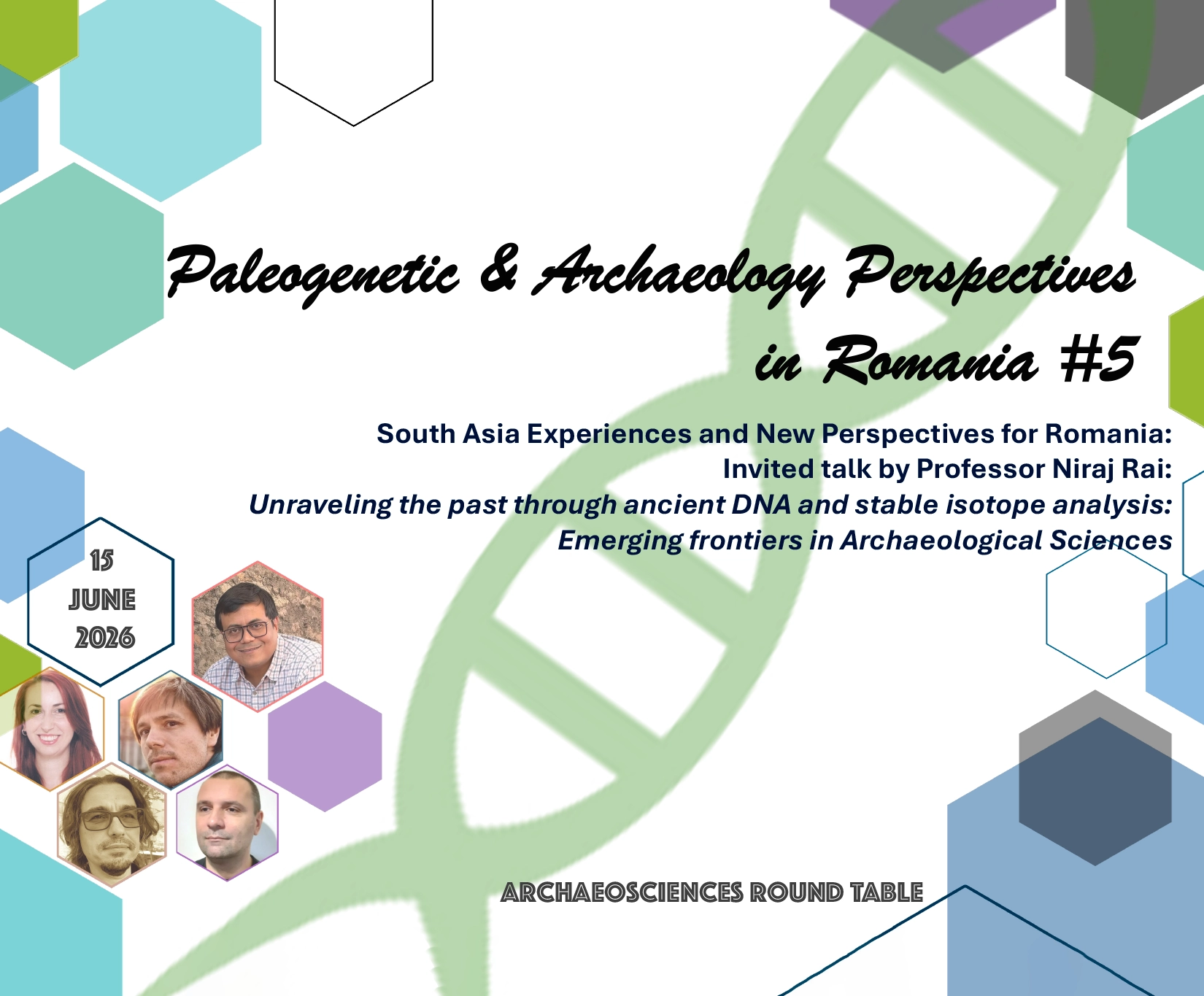
On Monday, 15 June 2026, will take place the fifth edition of the ArchaeoSciences Round Tables series, Paleogenetic & Archaeology Perspectives in Romania #5. The event is organised by the ArchaeoSciences Platform (ASp), Research Institute of the University of Bucharest (ICUB), in collaboration with the Faculty of Biology, University of Bucharest.
The event will be held starting at 14:00, in Room P04 of the Administrative Building, University of Bucharest Botanical Garden (Grădina Botanică).
This edition, titled South Asia Experiences and New Perspectives for Romania, features the invited talk by Professor Niraj Rai, “Unraveling the past through ancient DNA and stable isotope analysis: Emerging frontiers in Archaeological Sciences”. It continues the series of applied interdisciplinary meetings dedicated to strengthening dialogue between archaeology, paleogenetics, stable isotope research, archaeometry, population history, and advanced biomolecular research.
The round table will be built around the special invited guest, Prof. Niraj Rai, Head of the Ancient DNA Laboratory at the DST–Birbal Sahni Institute of Palaeosciences, Lucknow (India). He is also HEB Associate at the Department of Human Evolutionary Biology, Harvard Faculty of Arts and Sciences, and Visiting Scientist at CSIR–Centre for Cellular and Molecular Biology, Hyderabad. His research focuses on human population genetics, ancient DNA, migration histories, early farming strategies, and the reconstruction of prehistoric and modern population histories in South Asia.
The event will also bring together Dr. Mircea Iliescu (University of Cambridge, ICDG Bucharest, ICUB University of Bucharest), Prof. Sergiu Georgescu (Faculty of Biology, University of Bucharest), Dr. Ana García-Vázquez and Dr. Cătălin Lazăr (ASp–ICUB), together with students, doctoral candidates, early-career researchers, and colleagues interested in developing paleogenetic, isotopic, and archaeoscientific research in Romania.
The discussion will focus on how South Asian experience in ancient DNA and stable isotope research can provide a relevant comparative and methodological model for Romania. Particular attention will be given to:
- the organisation and development of ancient DNA research infrastructures and analytical workflows;
- the integration of ancient DNA and stable isotope data with archaeological, bioarchaeological, and archaeometric evidence;
- the complementary roles of ancient DNA and stable isotope analysis in reconstructing mobility, ancestry, diet, population interaction, and cultural transformation;
- the possibilities of adapting international best practices to Romanian archaeological contexts;
- the development of doctoral and postdoctoral research topics connected to ongoing fieldwork and laboratory programmes;
- the construction of long-term collaborations between Romania, India, the United Kingdom, and the United States.
The meeting is conceived as an open but focused academic dialogue, combining specialist perspectives with applied discussion. It aims to create a productive framework through which students and young researchers can better understand how ancient DNA and stable isotope research is designed, implemented, interpreted, and integrated within broader archaeological questions.
By placing South Asian experience in conversation with current research directions in Romania, this edition of the round table seeks to advance sustainable paleogenetic and stable isotope research in Romanian archaeology, while strengthening the international academic networks of the ArchaeoSciences Platform at ICUB.