




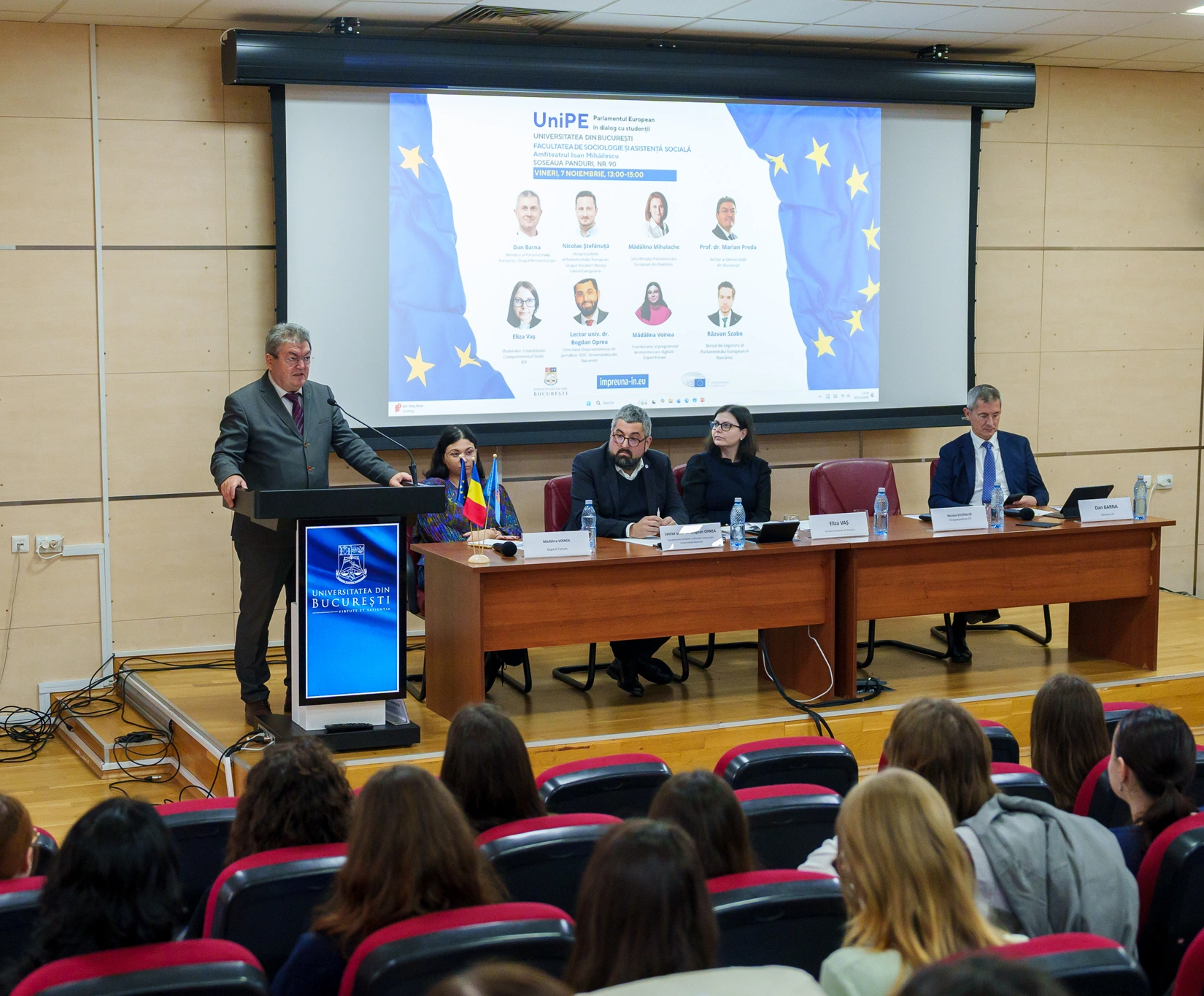
On Friday, November 7, 2025, the University of Bucharest, in partnership with the European Parliament Liaison Office in Romania, hosted the roundtable discussion “Disinformation and Artificial Intelligence – The EU’s Role in Combating This Phenomenon.” The event brought together Members of the Romanian Parliament and the European Parliament, professors and students from the University of Bucharest, as well as experts from civil society, for an open dialogue on one of the most pressing challenges of our time.

The event opened with remarks from Professor Marian Preda, PhD, Rector of the University of Bucharest, who underscored the importance of cooperation between academia and European institutions in addressing the complex challenges posed by artificial intelligence and disinformation. He also emphasized the essential role of education in fostering critical thinking among young people.
“The University of Bucharest is a large and diverse institution, with 20 faculties, 37,000 students, 2,500 staff members, more than 200 undergraduate programs, and 100 master’s programs. Our missions are education, research, and social responsibility. In this context, it is vital for the University of Bucharest to be truly autonomous. We must continue to develop study programs and research activities, but above all, we must cultivate a culture that defends freedom, democracy, equity, and social participation. These values can only thrive if the university itself remains a space for debate on current political and societal issues,” stated Professor Marian Preda, Rector of the University of Bucharest.

In her opening remarks, Mădălina Beatrice Mihalache, Head of the European Parliament Liaison Office in Romania, reaffirmed the institution’s commitment to fostering direct dialogue with young people, noting that initiatives such as UniPE help strengthen understanding of the European Union’s democratic values and decision-making processes.
“We all know that young people represent the future of European society – and that is precisely why dialogue is essential: to listen, to gather feedback, and to ensure that political groups respond effectively to their needs. In this spirit, the European Parliament Liaison Office launched the UniPE initiative. The topics of today’s debate – disinformation and artificial intelligence – are highly relevant. Disinformation has existed for a long time, but in light of the hybrid war unfolding at our borders, it is now more important than ever for Europe to combat it in order to protect its citizens,” emphasized Mădălina Beatrice Mihalache.
The event also featured an extensive Q&A session, during which students engaged with Members of the European Parliament, University of Bucharest experts, and communication specialists on topics such as EU digital policy, information security, and the future of AI regulation – particularly in shaping Europe’s response to Foreign Information Manipulation and Interference (FIMI).

In this context, Members of the European Parliament Nicolae Ștefănuță (Greens/European Free Alliance) and Dan Barna (Renew Europe) discussed the impact of emerging technologies on democratic processes and the need for coherent European policies to counter online disinformation.
“The struggle between truth and falsehood, good and evil, has always existed – only the tools have changed. Each generation has had its trusted sources of information. What matters most is our ability to adapt, both socially and individually, so that we don’t become social zombies. Our collective chance to thrive lies in our ability to think critically and remain skeptical until proven otherwise,” stressed Dan Barna, MEP.
“Artificial intelligence is transforming everything. Very soon, we will no longer be able to tell the difference between what is true and what is false, between science and myth – and this distortion of truth will have devastating effects across all areas of life: science, politics, ecology, and the labor market,” added Nicolae Ștefănuță, MEP.

Representing the academic community, Lecturer Bogdan Oprea, PhD, Director of the Department of Journalism at the Faculty of Journalism and Communication Studies, offered a practical perspective on how journalism and media education can help limit the spread of false information: “To counter disinformation, access to accurate information and transparency are essential. At the Faculty of Journalism and Communication Studies, we offer courses on disinformation and manipulation, which attract a large number of students every year.”

Mădălina Voinea, Digital Monitoring Program Coordinator at Expert Forum, presented recent findings from online monitoring activities and underlined the importance of digital literacy: “Artificial intelligence challenges us to pay closer attention to the truth and to act more responsibly in the online environment.”

In closing, Răzvan Szabo, Project Coordinator at the European Parliament Liaison Office in Romania, introduced a series of current European initiatives and opportunities for young people interested in EU affairs.

Moderated by Eliza Vaș, Head of the Research Department at the European Institute of Romania, the roundtable provided an open forum for debate and reflection on the challenges of the digital era in Europe, contributing to the development of a culture of accurate and responsible information among young people.
Postări asemănătoare:
 UniPE – The European Parliament in dialogue with students from the University of Bucharest: “Disinformation and Artificial Intelligence – The EU’s role in combating this phenomenon”
 The students of the University of Bucharest, invited to a new dialogue with the President of the European Parliament, Roberta Metsola. Event hosted by Bucharest National Opera
The students of UB, invited to a new dialogue with the President of the European Parliament, Roberta Metsola. Event hosted by Bucharest National Opera
The students of the University of Bucharest, invited to a new dialogue with the President of the European Parliament, Roberta Metsola. Event hosted by Bucharest National Opera
The students of UB, invited to a new dialogue with the President of the European Parliament, Roberta Metsola. Event hosted by Bucharest National Opera
 Qatar Officials Present at the Roundtable „From Mediation to Resolution: Qatar’s Role in Global Peace Building” Organized at the University of Bucharest
