





The Research Institute of the University of Bucharest (ICUB) is pleased to announce the 42nd ArchaeoSciences seminar. This edition’s guest speaker is Dr. Gelu Costin from Rice University (Houston, Texas) who will present a lecture titled: “EPMA and its potential applications in archaeochemistry”.
The seminar will take place on May 30, 2025, starting at 11:00 (EET), at the Administrative Building within the “Dimitrie Brândză” Botanical Garden (Șoseaua Cotroceni 32, Bucharest), room P08.
Gelu Costin is a researcher and manager of the Electron Probe Micro-Analyzer (EPMA) Laboratory from Rice University, Houston, Texas, (Department of Earth, Environmental and Planetary Sciences), where he teaches optical mineralogy and petrography courses. With over 30 years of experience in research and international higher education (USA, South Africa, Romania, France), his activity focuses on magmatic and metamorphic petrology, mineralogy, thermodynamic modelling and high-precision geochemical analysis.
He has two PhDs in geology and petrology obtained at the “Jean Monnet” University, France, and the University of Bucharest, Romania, and has published over 80 scientific articles in prestigious international journals. He worked as lecturer and researcher at universities from Romania, France, South Africa and USA, and was involved in major projects, like RRUFF, or geological studies of the Bushveld Complex, Martian meteorites and the MIST algorithm, which handles geochemical data sent by the Perseverance rover from Mars, and also the obtaining of 2D nano-materials derived from minerals. He is a reviewer for academic journals and national agencies for research funding, as well as a mentor for master’s and Ph.D students.
The Electron Probe Micro-Analyzer (EPMA) technique is a high-precision analytical instrument, used for determining the chemical composition of solids by analyzing the X-rays generated by the interaction of an electron beam with the surface of the sample. Invented in 1951 by Raymond Castaing, EPMA combines principles from electronic microscopy with wavelength dispersion spectrometry (WDS) and energy dispersion spectrometry (EDS), offering both imaging observation and quantitative analysis on the micrometer scale.
The instrument used at Rice University, JXA-8530F Hyperprobe, is equipped with 5 WDS spectrometers, 12 diffraction crystals (analyzers) and integrated EDS and CL detection systems. It can detect elements from boron to uranium, with detection limits below 30 ppm, thus offering a remarkable level of sensitivity for research applications. The device is fully automated and allows a wide variety of analyses, from quantitative and qualitative determinations of elemental composition to detailed spatial mapping of the chemical distribution in geological and archaeological samples.
The quantitative analysis offers precise data on the oxide or elemental content of each mineral, while the line analysis allows the observation of chemical variations along a profile. WDS mapping is used to generate element distribution maps throughout the texture of rocks and materials, and the qualitative analysis provides spectra that are useful for the rapid identification of unknown minerals and phases. The Field Emission (FE) based technology, used instead of conventional thermoionic emission, offers superior resolution, a narrower electron beam and the capacity to analyze extremely fine particles,all crucial aspects in the study of archaeological microstructures.
In the field of archaeochemistry, FE-EMPA offers a number of valuable applications: high-resolutionimaging allows the identification of the distribution of minerals and pores in artifacts, and mineralogical and chemical analysis helps to determine the modal proportions of minerals in ceramics, rocks and metals. Through elemental mapping and elemental analysis in traces, compositions specific for raw materials, pigments or alloys can be indentified, allowing the investigation of ancient production technologies and material sources of origin. Furthermore, the analysis of obsidian and other volcanic materials aids in the reconstructian of prehistoric trade networks and population mobility.
EPMA stands out for its non-invasive character, high analytical precision and capacity to provide essential information about the cultural and technological history of artifacts, thus becoming an indispensable tool in modern archaeological sciences.
These seminars are an original initiative of the ArchaeoSciences Platform (ASp) at ICUB, which aims to provide an open space for professionals in archaeological sciences worldwide to share knowledge and engage with the latest methodological and theoretical advances in the study of the past. They also offer Romanian students a valuable opportunity to discover the interdisciplinary dimensions of archaeology and archaeosciences.
SECŢIUNE ACCESIBILIZATĂ PENTRU PERSOANELE CU DIZABILITĂŢI DE VEDERE
Postări asemănătoare:
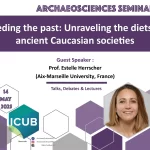 ICUB invites you to the lecture “Feeding the Past: Unraveling the Diets of Ancient Caucasian Societies”, delivered by Dr. Estelle Herrscher from Aix-Marseille Université, France
 ICUB invites you to the presentation “Technology without Nature and Mind without Reason: towards a semiotic theory of technology”, delivered by Alin Olteanu, from Shanghai International Studies University
 ICUB invites you to a double event: the 39th and 40th ArchaeoSciences Seminars, delivered by Dr. Arwa Kharobi and Dr. Kévin Salesse, from Masaryk University
