




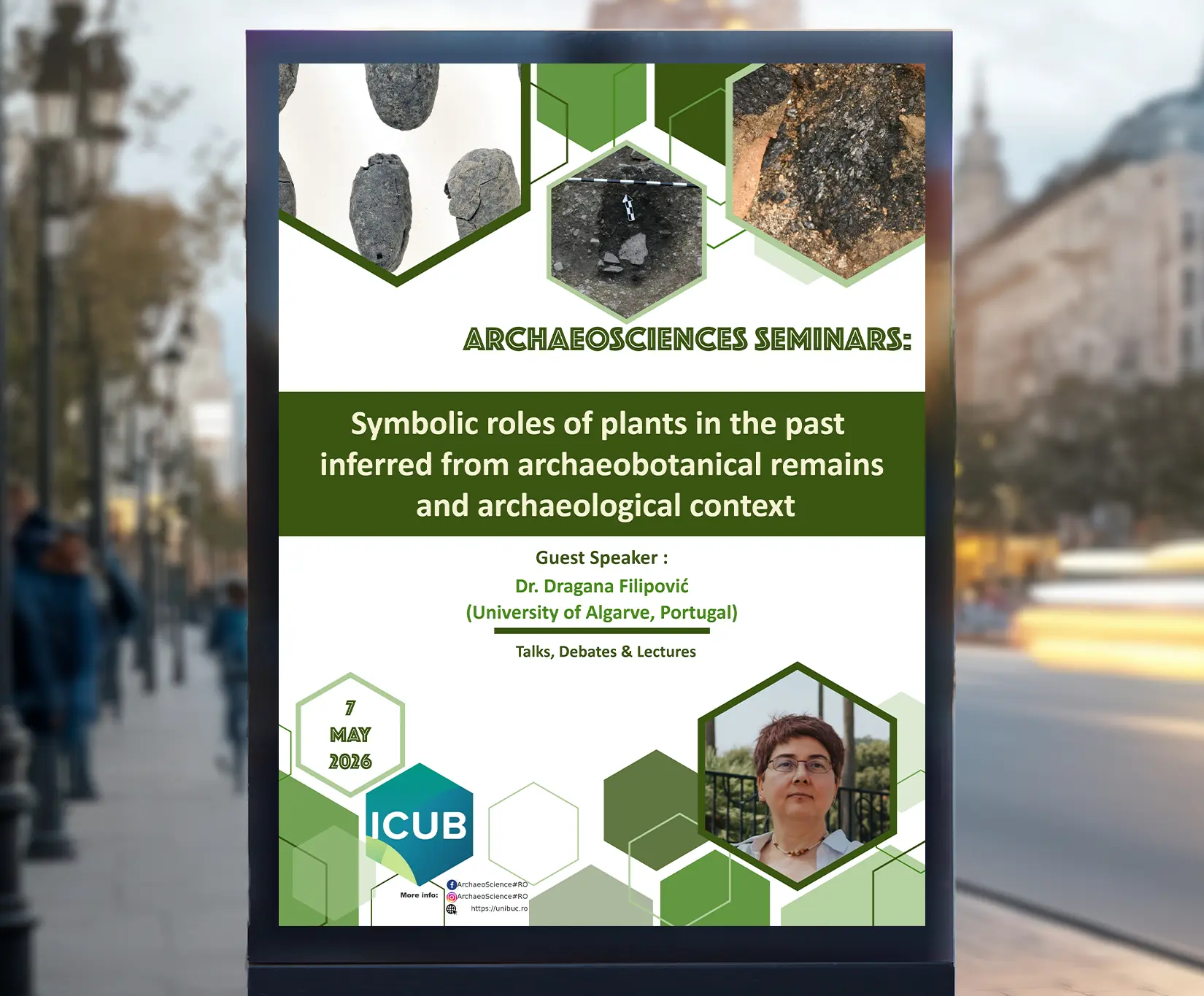
On Thursday, 7 May 2026, the Research Institute of the University of Bucharest (ICUB) invites you to the 52nd ArchaeoSciences seminar.
This edition’s guest speaker is Dr. Dragana Filipović from the University of Algarve (Portugal) who will present a lecture titled “Symbolic roles of plants in the past inferred from archaeobotanical remains and archaeological context”.
The seminar will take place starting at 11:00 (EET), at the at the Seminar classroom (former Herbarium) of the Faculty of Biology building at the Botanical Garden (Intrarea Portocalelor no. 3, basement floor).
About the presentation
Beyond food, fuel and craft material, plants served as symbols in myth, ritual and ceremonies. This is amply documented in historical writings, ethnographic accounts and art depictions. Symbolic role of plants is challenging to demonstrate archaeologically, especially where archaeobotanical macro- or micro-remains are scarce or missing altogether. As a complement or substitute to archaeobotany, biomolecular analyses applied in archaeology are successfully detecting the presence of plants in cultural deposits (e.g. sediments and organic residues, matrix of pots and basins). They can provide direct proof of plant preparation and use, and also broaden the taxonomic range determined through conventional studies of plant remains. Archaeobotanical investigation is still desired, as it can corroborate biomolecular findings and embed them in a more nuanced picture of plant provision and consumption, land use and socio-ecological environment of the individual or group under study. Many archaeological projects opt for conventional archaeobotany because of some practical aspects of biomolecular study, such as the price and expertise needed to run the analyses and explain the results. For either and both conventional and novel methodologies, precise documentation and full consideration of the archaeological context being analysed are essential, and can be particularly productive for the reconstructions of plant symbolism. Biological characteristics of the species encountered in ‘unusual’ contexts can also be indicative (e.g. appearance, physical or chemical properties), along with the historical and traditional knowledge and beliefs associated with them.
In this sense, the seminar presents several instances from prehistory and early history where combinations of conventional archaeological approaches, and the insights from ethnography and botany, have led Dr. Filipović to interpret plant remains as evidence of symbolic uses of plants in domestic and funerary contexts. Beyond their context-specific meaning, she uses these findings to discuss socio-political relations and the social role of plants, drawing on selected examples from later history and early modern times.
About the speaker
Dr. Dragana Filipović is an Integrated Researcher at the Interdisciplinary Center for Archaeology and the Evolution of Human Behaviour (ICArEHB) at the University of Algarve, Portugal. An expert archaeobotanist and archaeologist, her research explores the complex relationship between prehistoric societies and their environments. She specializes in the social, technological, and economic aspects of early plant production, with a particular focus on the transition to farming and the cultivation of crops during the Neolithic and Bronze Age.
These seminars are an original initiative of the ArchaeoSciences Platform (ASp) at ICUB, which aims to provide an open space for professionals in archaeological sciences worldwide to share knowledge and engage with the latest methodological and theoretical advances in the study of the past. They also offer Romanian students a valuable opportunity to discover the interdisciplinary dimensions of archaeology and archaeosciences.
Postări asemănătoare:
 ICUB invites you to the lecture „Cognitive and Semiotic Archaeology at the Service of Archaeological Science: The Case of Early Body Ornamentation”, delivered by Dr. Antonis Iliopoulos from Emory University, USA
 ICUB invites you to the lecture “Feeding the Past: Unraveling the Diets of Ancient Caucasian Societies”, delivered by Dr. Estelle Herrscher from Aix-Marseille Université, France
 ICUB invites you to the lecture “Off the beaten track: The Significance of the Black Sea Regions for European Neolithization”, delivered by Dr. Marta Andriiovych from the University of Oxford and the University of Bern
