




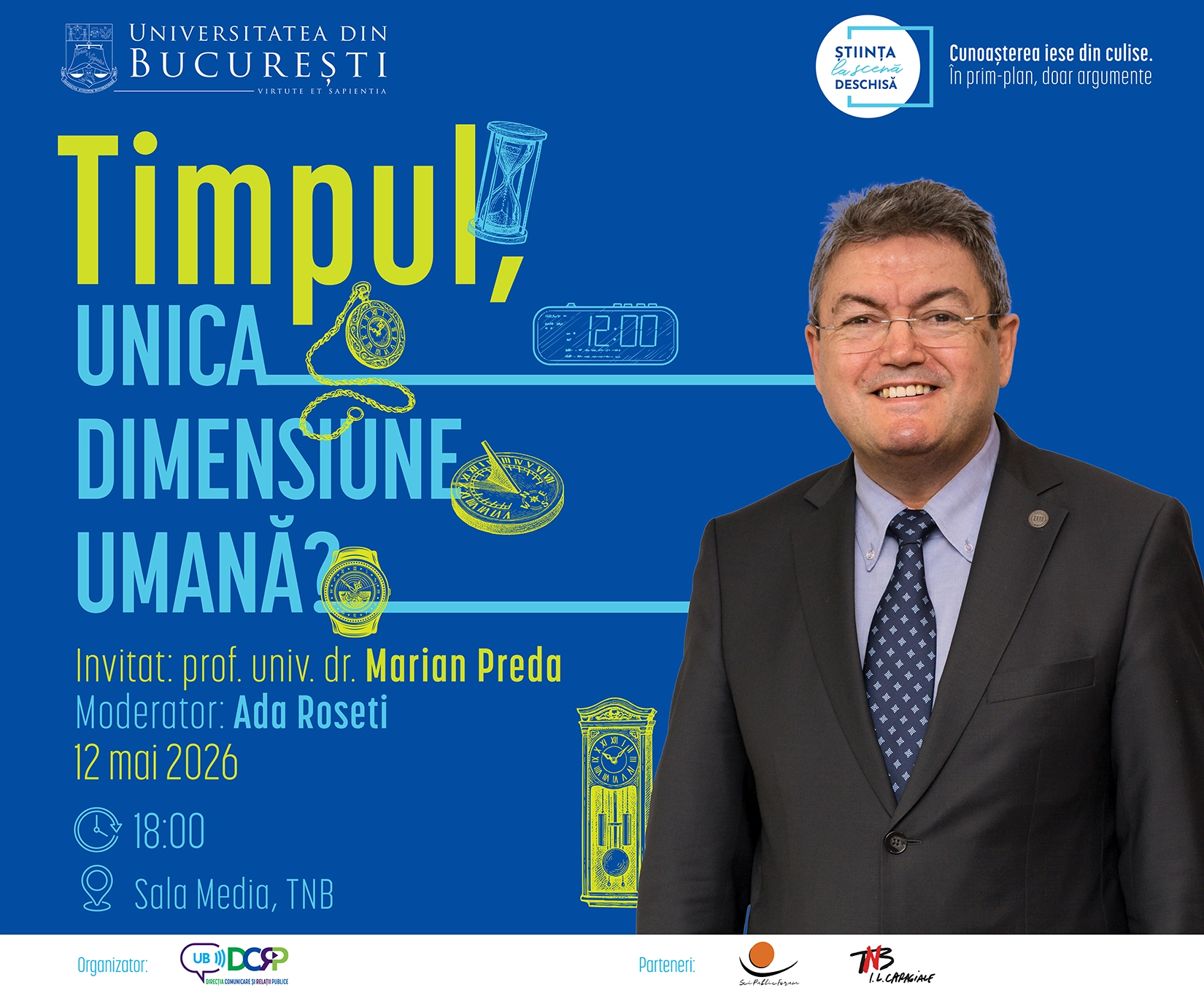
The University of Bucharest will host the third edition of its “Science on the Open Stage” conference series on Tuesday, May 12, 2026. The invited speaker, Marian Preda, PhD, Rector of the University and professor at the Faculty of Sociology – will offer a thought-provoking reflection, “Time: The Only Human Dimension?”, on how time shapes human experience and how we relate to this fundamental dimension of existence, both consciously and unconsciously.
The third lecture in this series is available below:
The event is organized by the University of Bucharest, through its Communication and Public Relations Department, in partnership with the SciPublic Forum Association. It will take place at the Media Hall of the I. L. Caragiale National Theatre in Bucharest, starting at 6:00 PM.
Participation is free of charge, subject to seat availability, and requires prior reservation. The event is open to the general public.
What is the true nature of time, and what does it mean for us? Is time simply a chronological dimension, measured with ever more precise tools throughout history, or is it a complex concept present across all fields of knowledge – from astronomy and linguistics to psychology, sociology, biology, and mathematics? To what extent are who we are – and who we become – shaped by the way we relate to time?
Starting from these questions, Marian Preda invites the audience to explore what might be called the “experience of time.” In this perspective, time is not merely an external framework but a uniquely human dimension – one that influences our perceptions, decisions, and life paths at the individual level. At the collective level, whether in communities or entire societies, “time capital” becomes a key factor shaping their development, transformation, and eventual decline.
In a world defined by acceleration and growing social entropy, where both individual and collective lives are increasingly measured, commodified, and compressed, and where personal time often feels fragmented and difficult to manage, reflecting on time becomes more important than ever.
Moving beyond traditional views, the lecture introduces the concept of time as “time capital”: the most fundamental resource each individual possesses. It is something we can invest, transform into knowledge and skills, and ultimately convert into economic value, material goods, ideas, or even scientific and spiritual insight.
Present in all areas of knowledge, time – this “time capital” we are born with – is constantly invested and transformed into economic, human, and social capital. Over time, it is gradually consumed, even beyond our lifetime, through the legacy of what we leave behind. In this sense, time can be seen as the fundamental human dimension, the essential condition of our existence.
From this perspective, time is not just an abstract framework in which life unfolds, but the very “currency” of our existence, something we can invest, spend, or waste. Who we are becomes inseparable from how we use our time. The distinction between measured time and lived time thus takes on deep significance: what matters is not simply how long something lasts, but the meaning we give to each moment. Reflecting on time ultimately becomes a reflection on freedom, responsibility, and the way we shape our own lives.
The event will be moderated by Ada Roseti, a science communication expert, founder of the SciPublic Forum Association, and initiator of the “Games of Science” competition.
Marian Preda is a sociologist and professor at the Faculty of Sociology and Social Work at the University of Bucharest, where he currently serves as Rector. He has been part of the university since 1990. Over the past three decades, alongside his academic work, he has been involved as a manager, consultant, or expert in numerous national and international projects, collaborating with organizations such as UNICEF, UNDP, the World Bank, and the European Commission.
He has also held several prominent roles, including President of the Presidential Commission for the Analysis of Social and Demographic Risks (2009–2010), President of the Romanian Sociological Society (2010–2012), and President of the National Statistical Council (2016–2018, 2018–2020, 2021–2023).
A member of the first generation of sociology students after the 1989 Revolution, Marian Preda earned a Master’s degree in Social Policy from the University of Bucharest in 2005 and a second Master’s in Business Administration from Tiffin University in 2006. He has also completed several international training programs, including at Anglia Ruskin University and George Washington University, supported by a Fulbright scholarship.
Between 2000 and 2015, he held leadership roles within the Faculty of Sociology and Social Work, first as Vice-Dean (2000–2008) and then as Dean (2008–2015). He later served as President of the University Senate (2015–2019) and as Rector (2019–2023). Since 1994, he has taught courses in Strategic Management, Organizational Behavior, Social Policy, and the Sociology of Time.
UB conference series: “Science on the Open Stage”
The “Science on the Open Stage” conference series is organized by the University of Bucharest’s Communication and Public Relations Department in collaboration with the SciPublic Forum Association. Its aim is to break down traditional barriers between academia and the general public by creating a space where specialists from various fields can discuss current topics.
The invited speakers are professors, researchers, and prominent figures from different scientific domains. By encouraging an authentic connection between the academic community and the public, the series not only “explains” science but presents it as a spectacle of knowledge, where fundamental aspects of reality are examined through solid arguments and the audience is invited to actively participate in the discussion.
The event follows a dynamic format designed to facilitate both understanding and meaningful dialogue with the audience.
The conference will begin with a roughly 20-minute lecture introducing key concepts, followed by a brief 5-minute Q&A session to reinforce the main ideas. Next, the speaker will present a 15-minute applied segment illustrating the concepts through concrete examples, case studies, or real-life situations. The event will conclude with an extended Q&A session of approximately 40 minutes, encouraging active audience participation and deeper exploration of topics of interest.
The “Science on the Open Stage” series reaffirms the University of Bucharest’s commitment to making high-quality science accessible to the public, as well as to educating, inspiring, and connecting people in Romania. It comes at a time when discussions about the role of science in society – from global challenges such as climate change and public health to critical thinking and democracy—are essential for shaping informed and responsible citizens.
To support this mission, the University of Bucharest has launched an extensive Science Communication Program aimed at promoting the research activity of its academic community and facilitating dialogue between researchers and the public.
Among its most recent initiatives are the platforms hartacercetatorilor.ro and descopeRO.unibuc.ro, which complement conferences and multimedia series dedicated to science communication, such as “UB’s Science Dose,” “microSCOP: UB Researcher at the Microphone,” “Project Under the Lens,” “ICUB Meetings,” and “Conversations with SKEPSIS.”
Postări asemănătoare:
 “Time Is the Only Capital We Are Born With” – Professor Marian Preda, Guest of the Third Edition of the “Science on the Open Stage” Conference Series
 When extremes become the norm: Bogdan Antonescu takes the stage at the University of Bucharest
 When extremes become the norm: Bogdan Antonescu takes the stage at the University of Bucharest
 “Millions of invisible lives within our bodies shape our health and well-being” – Prof. Carmen Chifiriuc, PhD guest of the first edition of the “Science on the open stage” conference series
