




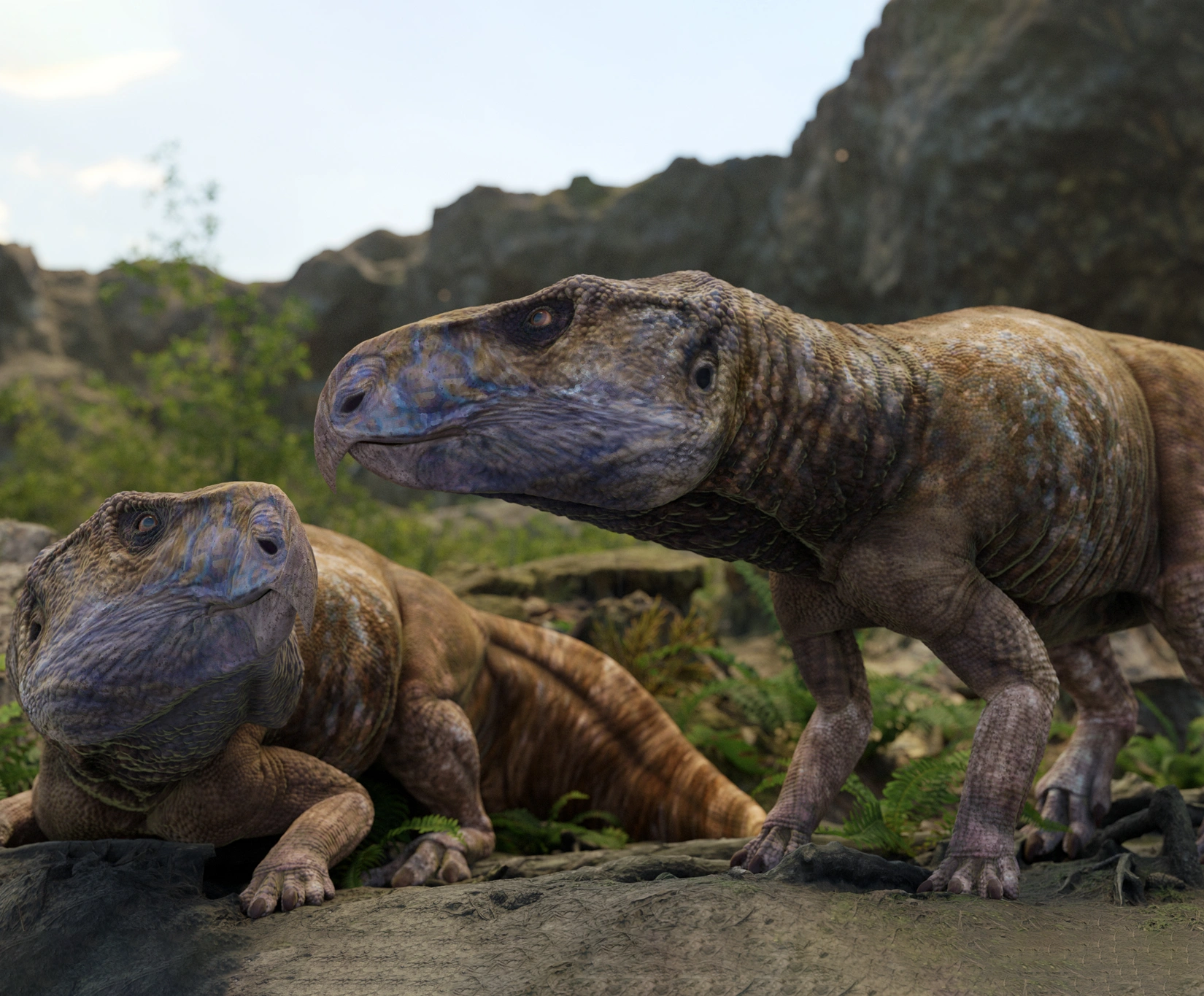
Nature, the world’s leading international scientific journal, has published a study that fundamentally reshapes our understanding of ceratopsians, “horned dinosaurs” from the Late Cretaceous period. The research was conducted by an international team led by Professor Susannah Maidment of the Natural History Museum in London, together with specialists from leading research institutions in the United Kingdom, Hungary, Germany, and Romania. Among the contributors is Associate Professor Dr. Zoltán Csiki-Sava, a researcher and faculty member at the Faculty of Geology and Geophysics, University of Bucharest. Some of the fossils underpinning this groundbreaking study were discovered in the UNESCO International Geopark Țara Hațegului, part of the natural and scientific heritage administered by the University of Bucharest.

The study overturns a scientific assumption that has persisted for more than a century: that ceratopsians, dinosaurs renowned for their distinctive skulls and horns, never reached Europe. New evidence reveals that Europe’s Cretaceous fauna was far more diverse than previously believed. Fossils from Romania and Hungary demonstrate that ceratopsian dinosaurs were indeed present in the region and evolved distinctive local adaptations. These findings offer a new perspective on Europe’s role in deep time, suggesting that the continent functioned as an important arena for dinosaur evolution and intercontinental connectivity.
“These results fundamentally change how we understand the evolution of Europe’s Cretaceous fauna. The fossils discovered, including those from the UNESCO International Geopark Țara Hațegului, show that ceratopsians not only reached the former European archipelago but also evolved unique forms adapted to island environments. Our studies indicate that some fossils previously assigned to rhabdodontids – an herbivorous dinosaur group thought to be endemic to Europe – actually belong to atypical horned dinosaurs. Europe may even have served as a key dispersal corridor between Asia and North America for these animals”, says Associate Professor Dr. Zoltán Csiki-Sava.
Fossils from the UNESCO International Geopark Țara Hațegului – one of the most important paleontological regions in the world – played a crucial role in this discovery. Based on material from the Sînpetru Formation in the southern Hațeg Basin, researchers identified a new dinosaur genus: Ferenceratops shqiperorum, a primitive ceratopsian species. The name honors Baron Franz (Ferenc) Nopcsa, a pioneer of paleontological research in the Hațeg region and one of the most influential paleontologists of the early 20th century. Nopcsa was also the original discoverer of the fossil material that now serves as the species’ holotype.
Professor Susannah Maidment of the Natural History Museum in London, who coordinated the study, explains why these animals remained so difficult to identify for so long: “Although Iguanodon and Triceratops look very different, the groups they belong to evolved from a common ancestor and share certain inherited traits. Both groups independently evolved four-legged locomotion, complex chewing mechanisms, and large body sizes. As a result, their teeth and limb bones can look surprisingly similar, due both to their shared evolutionary history and comparable lifestyles. When only fragmentary remains are available, it can be extremely challenging to determine exactly which animal you are dealing with.”
The Romanian fossil evidence complements recent major discoveries from the Late Cretaceous of Hungary, where far more complete cranial remains than previously known have been identified from Ajkaceratops kozmai, a horned dinosaur whose evolutionary affinities had long been debated. The newly discovered skull material unequivocally confirms that this species belongs to the ceratopsian group.

Together, the Romanian and Hungarian discoveries highlight both the importance of international collaboration in paleontological research and the central role of the Hațeg region in reconstructing the evolution of Europe’s Cretaceous fauna. The study opens new avenues of investigation and strengthens the global scientific standing of the UNESCO International Geopark Țara Hațegului, part of the heritage administered by the University of Bucharest. The significance of the discovery is further underscored by evidence that some fossil material previously attributed to the herbivorous dinosaur Zalmoxes displays clear ceratopsian characteristics. This suggests that the identity and diversity of herbivorous dinosaurs in the Hațeg Basin will require substantial re-evaluation.
Professor Steve Brusatte, one of the world’s leading vertebrate paleontologists and a co-author of the study, emphasizes the broader implications of reinterpreting Europe’s fossil record: “Horned dinosaurs like Triceratops are among the most famous dinosaurs, but most known species come from North America. Now we’re finding them in Europe as well – where they were hiding in plain sight, misidentified for decades as members of other dinosaur groups.”
The article is available in English on the Nature website:
https://www.nature.com/articles/s41586-025-09897-w.
Ranked the best university in Romania for interdisciplinary scientific research according to the Times Higher Education – Interdisciplinary Science Rankings 2026, the University of Bucharest, founded in 1864, continues the academic tradition of the Princely Academy established in 1694.
Since 2019, the University of Bucharest has been a member of the European Civic University Alliance (CIVIS), alongside ten other prestigious European universities. Through this alliance, UB plays an active role in the development and modernization of education, science, and culture at both national and international levels, and is increasingly becoming a key player in shaping European higher education.
Today, the University of Bucharest is Romania’s leading institution for interdisciplinary scientific research, according to the second edition of the Times Higher Education – Interdisciplinary Science Rankings 2026. It is a place where linguistics and modern languages intersect with physics and astronomy, fostering a dynamic environment for research, education, and innovation, one in which sustainability, sustainable development, and social responsibility are core principles.
By assuming an active role in society, the University of Bucharest promotes education and research with strong social impact, contributing to the reduction of inequalities, the strengthening of social cohesion, and the formation of responsible, engaged citizens. The social dimension of UB’s mission is closely linked to its commitment to sustainability, sustainable development, and respect for the community. As a result, the University of Bucharest ranks first in Romania and among the top 100 universities worldwide for its engagement in sustainable development activities, according to the Times Higher Education Impact Rankings 2025, one of the most widely recognized international academic rankings. UB’s strongest performance in this ranking is for Sustainable Development Goal 5 – Gender Equality, where it ranks 3rd globally.
The University of Bucharest is also currently ranked as the best university in Romania for international students, according to the latest edition of Study Abroad Aide’s World University Rankings 2025.
Moreover, the University of Bucharest reaffirms its leadership in Romanian higher education in the QS World University Rankings 2026, one of the world’s three most influential academic rankings. Globally, UB is ranked in the 761–770 band, representing a significant improvement from the previous 801–850 band and marking one of its strongest performances of the past decade. UB’s results are particularly notable in Employment Outcomes and Employer Reputation, confirming its ability to educate competitive, job-ready graduates. According to the latest data, 81.1% of UB graduates secure employment within 7–11 months after completing their studies.
Postări asemănătoare:
 Researchers from the Faculty of History at the University of Bucharest, co-authors of the study „The Genetic Origin of the Indo-Europeans” on the origin of the Indo-Europeans, published in „Nature” journal
 “Roman Mobilities” CIVIS BIP, hosted by the Department of Ancient History, Archeology and History of Arts of the UB Faculty of History
 The University of Bucharest announces the launch of the evaluation results for ICCS – International Civic and Citizenship Education Study, the largest and only dedicated study of civic and citizenship education
 The University of Bucharest announces the launch of ICCS 2022 results – International Civic and Citizenship Education Study, the largest and only dedicated study of civic and citizenship education
