




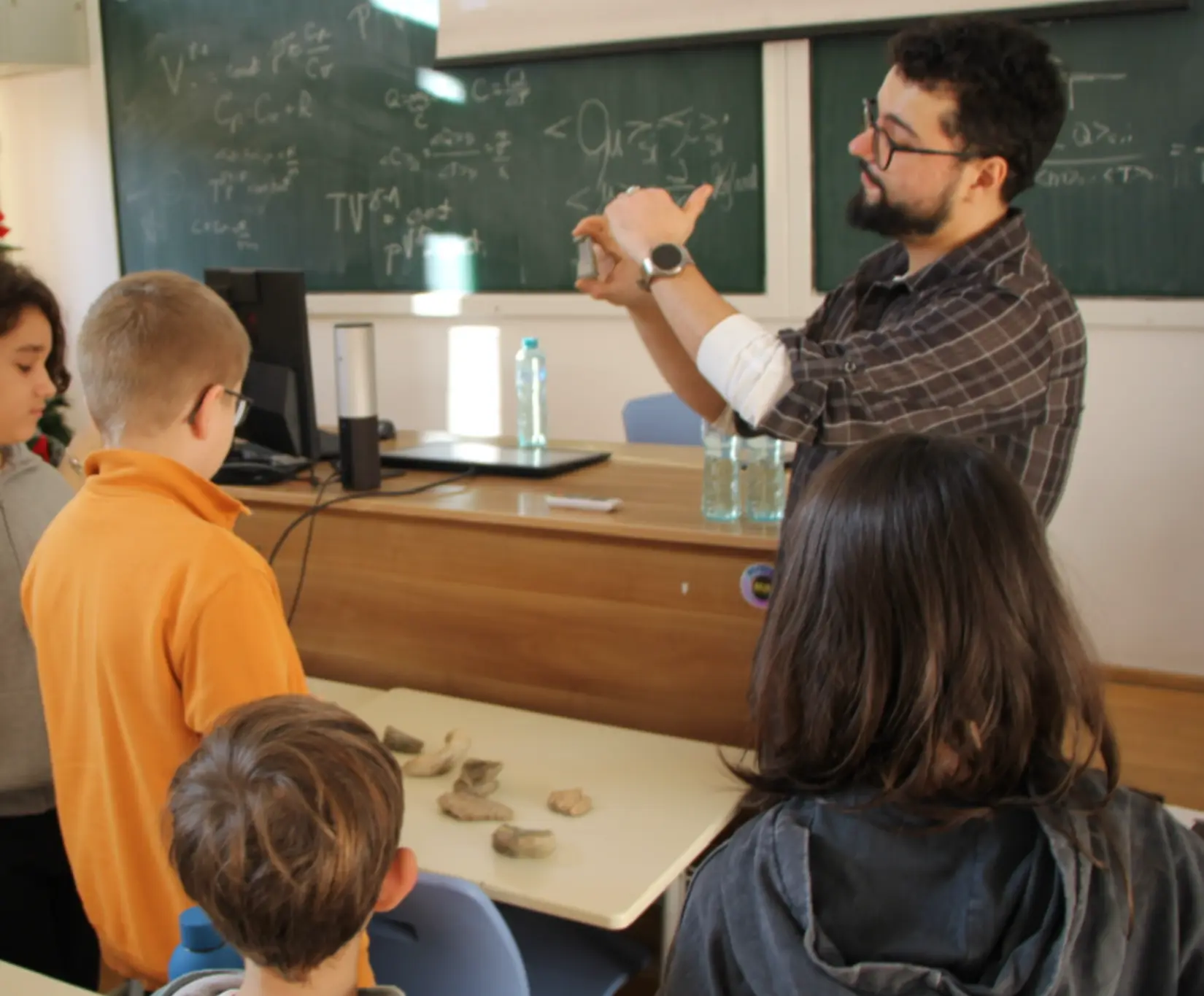
The collaboration between the Research Institute of the University of Bucharest (ICUB), through the ArchaeoSciences Platform, and the “Gheorghe Lazăr” National College continued on Saturday, December 13, 2025, with a new STEM educational event, featuring a presentation and interactive activities addressed to the College’s primary and middle school students. This time, archaeology and the investigation of prehistory using modern methods took centre stage in a dynamic session that sparked the interest and questions of the young students.
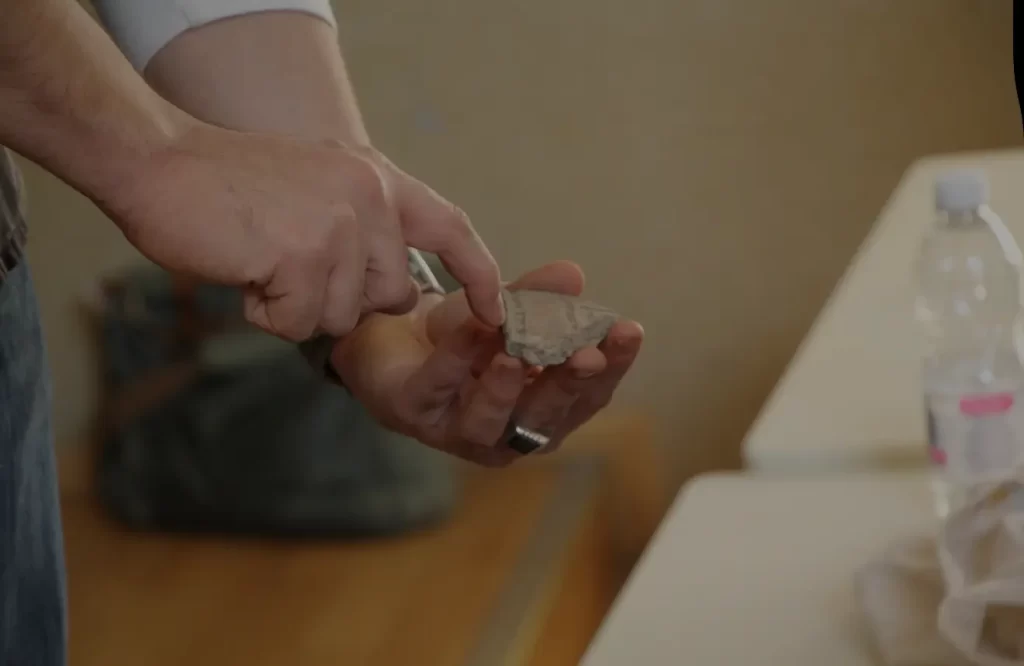
The event constituted a captivating foray into the world of archaeology and the human past, offering participants the opportunity to come into direct contact with material history. The presentation transcended the usual theoretical barriers, taking the students on a journey through time, from the Paleolithic and Neolithic to the Metal Ages and the modern era. By offering the possibility to study authentic artefacts and to interactively explore the humanity’s great transformations (such as agriculture, animal domestication, sedentarisation, and the development of material culture), the experience delivered by the ArchaeoSciences team raised captivating questions and transformed abstract concepts into tangible reference points.
A central point of the discussions, meant to facilitate a deep understanding of the research process and how food surplus and sedentary life shaped human society, was the application of exact sciences in the study of the “People of the Past,” under the aegis of #ArchaeoSciences. Students had the opportunity to see how modern technology, such as Scanning Electron Microscopy (SEM), allows for the analysis of details invisible to the naked eye, alongside geophysical investigations and interdisciplinary approaches. The various archaeological analysis techniques presented revealed unexpected facets of artefact study: from the microscopic analysis of charcoal to understand the environment, to the investigation of stone tools and jewellery, all spoke to the students about daily life and the human experience. Methods for reconstructing ancient diets, the importance of 3D scanning, and experimental archaeology were also discussed. Thus, archaeology was presented not just as a science of “discovering artefacts,” but as a complex interdisciplinary instrument for investigating humanity’s past.


Postări asemănătoare:
 ICUB and ArchaeoSciences Platform Bring Interdisciplinary Archaeology to Students within the “Gheorghe Lazăr” College’s TITANS Academy
 The University of Bucharest Won the “Interdisciplinary Institutional Platform for Excellence in Research, Development and Professional Training in the Field of Archaeological Sciences” Project within the “Institutional Development Projects – RDI Excellence Funding Projects” Competition
 The University of Bucharest Won the “Interdisciplinary Institutional Platform for Excellence in Research, Development and Professional Training in the Field of Archaeological Sciences” Project within the “Institutional Development Projects – RDI Excellence Funding Projects” Competition
 ICUB invites you to the presentation “Technology without Nature and Mind without Reason: towards a semiotic theory of technology”, delivered by Alin Olteanu, from Shanghai International Studies University
