




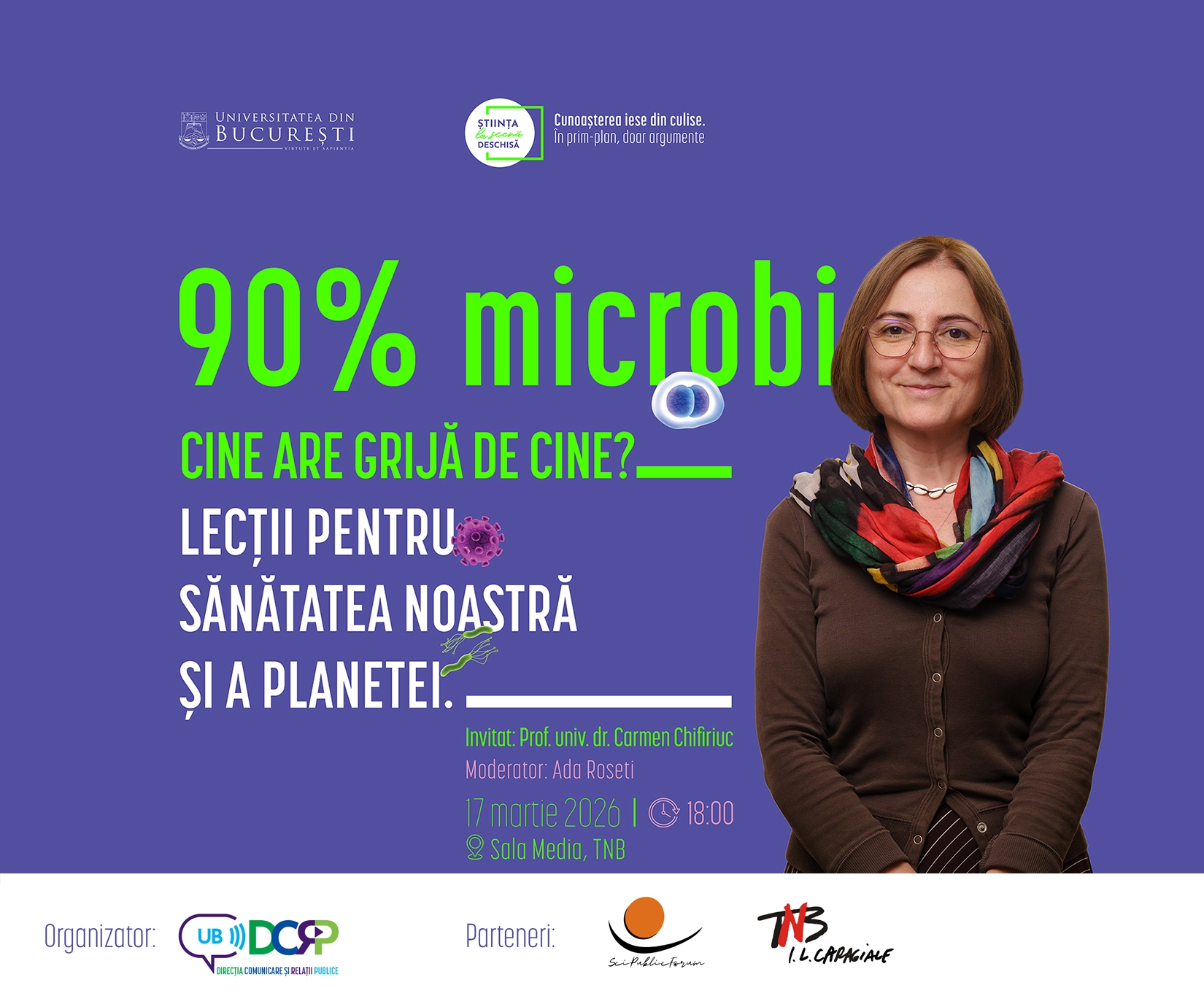
The University of Bucharest announces the launch of the lecture series “Science on the open stage” and will host the first event of this new initiative on Tuesday, March 17, 2026. The project aims to bring scientific culture closer to the general public. The inaugural edition will feature Professor Carmen Chifiriuc, PhD, researcher and faculty member at the University of Bucharest, who will deliver the lecture “90% Microbes. Who takes care of whom? Lessons for our health and the health of the Planet.”
The first lecture in this series is available below:
The event is organized by the University of Bucharest, through its Communication and Public Relations Department, in collaboration with the SciPublic Forum Association, and will take place in the Media Hall of the “I. L. Caragiale” National Theatre in Bucharest, starting at 6:00 PM.
Attendance is free of charge, within the limit of 120 seats, and requires prior registration
In an accessible format grounded in today’s realities, Prof. Carmen Chifiriuc will invite the audience on a fascinating journey into the invisible world of the microbiome – the microscopic universe that lives inside and around us and profoundly influences our health and well-being.
The lecture will explore how microorganisms have shaped the evolution of life on Earth and how the balance between microorganisms and their host organisms is essential to both individual and collective health. Beyond scientific information, the event aims to encourage a shift in perspective: moving from the idea that humans are separate from and dominant over nature toward an integrative “One Health” vision, where human health, animal health, and environmental balance are deeply interconnected.
In the context of rising antibiotic resistance, ecological imbalances, and the emergence of new pathogens, understanding our relationship with microorganisms becomes increasingly necessary in order to cultivate informed and responsible behaviors – essential in a rapidly changing world.
The event will be moderated by Ada Roseti, science communication expert, founder of the SciPublic Forum Association, and initiator of the “Games of Science” competition.

Prof. Carmen Chifiriuc is a biologist specializing in microbiology and immunology and a faculty member at the Faculty of Interdisciplinary Studies at the University of Bucharest.
She currently serves as Vice-Rector for Research at the University of Bucharest, where she has coordinated the university’s scientific research activity and the work of the University of Bucharest Research Institute since 2019.
Prof. Dr. Chifiriuc began her research career in 1997 as a biologist in the Vibrio Laboratory of the “I. Cantacuzino” National Institute for Medical-Military Research and Development in Bucharest.
She has been a fellow of the International Network of Pasteur Institutes in Bangui and Paris, and in 2005 she defended her doctoral thesis on the interaction between parasites and the immune status of the host. As a national manager, she contributed to Romania’s inclusion in the European Antimicrobial Resistance Surveillance Network (EARSS).
She has been continuously active at the University of Bucharest since 2003, where alongside her teaching activity she has coordinated numerous nationally and internationally funded research grants and has been part of the teams of more than 50 research projects.
Her main research areas include: investigating reservoirs of virulence and antibiotic resistance in clinical and environmental settings, studying host–infectious agent interactions, examining the role of microbiota in various pathologies and anti-infectious immunity, developing rapid microbiological diagnostic methods, developing and evaluating new antimicrobial strategies with applications in biomedical science and ecology.
The University of Bucharest “Science on the open stage” lecture series
The “Science on the open stage” lecture series, organized by the University of Bucharest’s Communication and Public Relations Department in collaboration with the SciPublic Forum Association, aims to break down the traditional barriers between academia and the general public by creating a space where specialists from various fields can discuss topics of contemporary relevance.
The invited speakers include professors, researchers, and prominent figures from different scientific disciplines.
By encouraging authentic connections between the academic community and the public, the series seeks not only to explain science, but to present it as a spectacle of knowledge, where fundamental themes of reality are explored through solid arguments and where the audience is invited to actively participate in the discussion.
The event follows a dynamic format designed to facilitate both understanding and dialogue with the audience. The lecture will begin with a 20-minute presentation introducing the topic and clarifying key concepts, followed by a short 5-minute Q&A session to consolidate the main ideas. Next, the speaker will present an applied segment of approximately 15 minutes, illustrating the concepts discussed through concrete examples, case studies, or situations relevant to everyday life. The event will conclude with an extended Q&A session of around 40 minutes, encouraging active audience participation and deeper exploration of the topic.
The “Science on the Open Stage” lecture series reaffirms the University of Bucharest’s commitment to making high-quality science accessible to the wider public and to educating, inspiring, and connecting people in Romania.
It also comes at a time when debates about the role of science in society – from global challenges such as climate change and public health to critical thinking and democracy –are essential for shaping informed and responsible citizens.
To support this mission, the University of Bucharest has launched a Science Communication Program aimed at promoting the research activity of its academic community and facilitating dialogue between researchers and the public. Initiatives within the program include thematic conferences, multimedia science communication series such as “UB’s Dose of Science,” “microSCOP: UB Researcher at the Microphone,” “Project Under the Lens,” “ICUB Meetings,” and “SKEPSIS,” as well as editorial content including articles, interviews, and audio-video reports published on the university’s platforms.
Postări asemănătoare:
 The University of Bucharest launches the “Science on the open stage” lecture series. The first guest, Professor Carmen Chifiriuc, PhD, invites the public on a journey into the universe of the microbiome
 “Millions of invisible lives within our bodies shape our health and well-being” – Prof. Carmen Chifiriuc, PhD guest of the first edition of the “Science on the open stage” conference series
 “Time Is the Only Capital We Are Born With” – Professor Marian Preda, Guest of the Third Edition of the “Science on the Open Stage” Conference Series
 The University of Bucharest launches the “SKEPSIS” series. An episode on trust in homeopathic practices, with prof. Cosima Rughiniș, PhD, and Dragoș Obreja, PhD
