




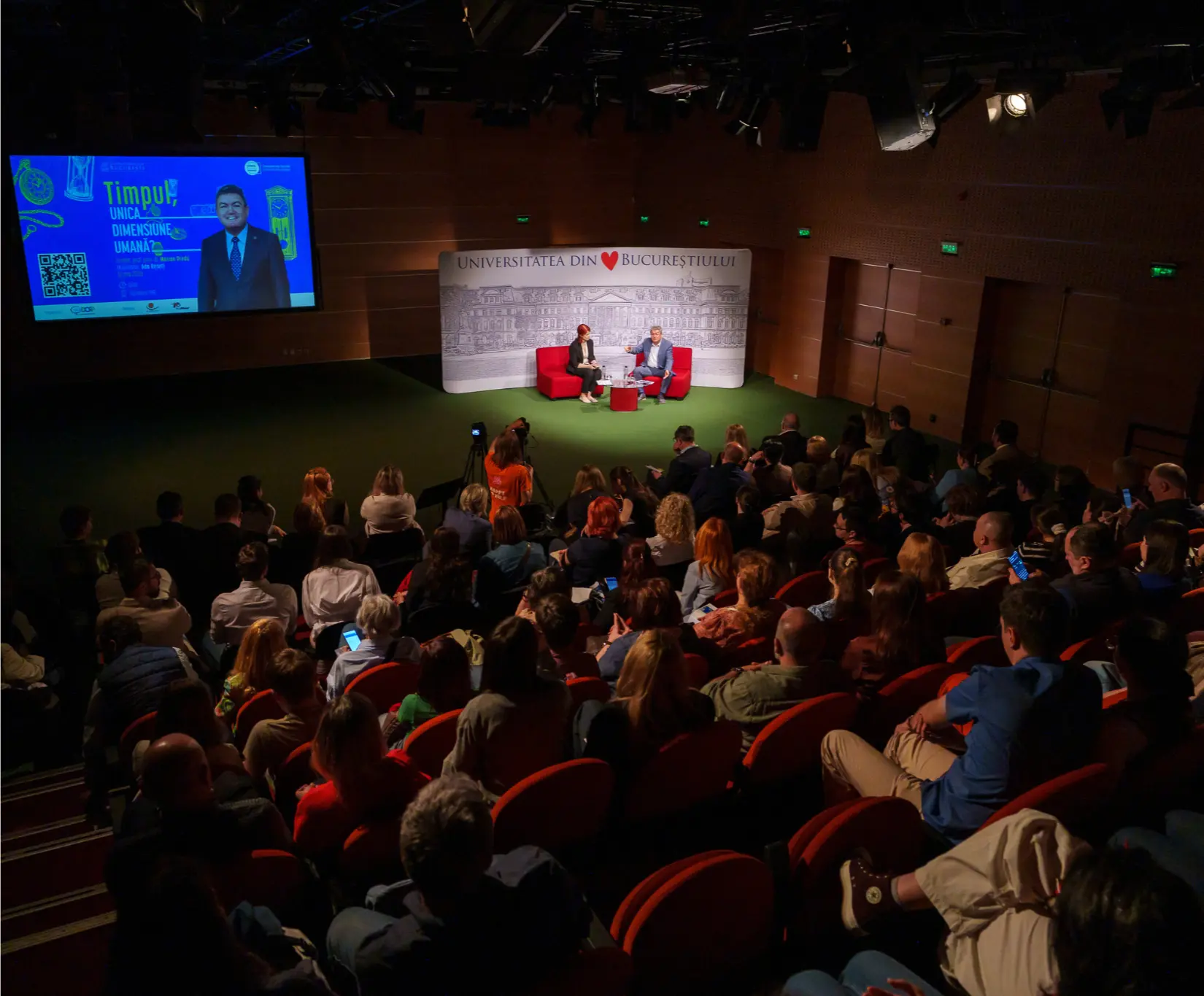
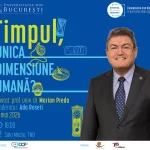
On Tuesday, May 12, 2026, the University of Bucharest organized the third edition of the “Science on the Open Stage” conference series, featuring Professor Marian Preda, sociologist, Rector of the University of Bucharest, and faculty member at the university’s Faculty of Sociology and Social Work as guest speaker.
During the lecture, entitled “Time, the Only Human Dimension?”, sociologist Marian Preda invited the audience to engage in an interdisciplinary reflection on the way time structures human experience and shapes our relationship with this fundamental dimension of existence.
The event took place in the “Media” Hall of the I. L. Caragiale National Theatre of Bucharest and was organized by the University of Bucharest, through its Communication and Public Relations Department, in collaboration with the SciPublic Forum. The conference was moderated by Ada Roseti, founder of the SciPublic Forum Association and initiator of the “Games of Science” competition.
In the opening of the event, Marian Preda emphasized the importance of bringing academia closer to the general public, stating that “the University of Bucharest aims to extend the scientific stage beyond specialists.” Starting from the idea that “the world is made up of events, not things,” a formulation borrowed from the reflections of physicist Carlo Rovelli, the sociologist explored the ways in which time structures memory, experiences, and both individual and collective identity.
The conference addressed events that shape entire generations and become collective temporal landmarks – from the 1969 Moon landing and the September 11, 2001 attacks to deeply personal experiences marked by strong positive or negative emotions, such as examinations, births, or memorable encounters. According to the sociologist, these experiences become “temporal events” that structure the way people construct memory and biography.
Professor Marian Preda also examined the historical evolution of how people have measured and organized time, from hourglasses and clocks to pocket watches, wristwatches, and mobile phones. Instruments for measuring time, he argued, have served not only practical purposes but also functioned as mechanisms of social synchronization: while “the church clock” synchronized entire communities in the past, contemporary technologies accelerate and fragment the rhythm of everyday life. In this context, the Rector of the University of Bucharest spoke about the “time crisis” characteristic of contemporary society, marked by the constant overlap of activities and the pressure of continuous synchronization.
The central idea of the conference was the concept of “time capital,” developed by sociologist Marian Preda and his research team as early as 2010. The concept defines time as the fundamental resource each individual possesses and can invest, transforming it into skills and knowledge capable of generating economic capital, money, material goods, ideas, scientific understanding, or spiritual knowledge.
“Our time is the only type of capital inseparable from us, from our bodies, from each individual’s very being,” was one of the definitions presented during the lecture.
From this perspective, time is not merely a chronological sequence measured by clocks, but a resource that can be invested, consumed, accelerated, or wasted. The conference also explored the distinction between objective time and psychologically perceived subjective duration, as well as the ways memory and emotions shape our experience of time.
Professor Marian Preda also discussed the challenges posed by new technologies and artificial intelligence in relation to time and memory. In a society that produces and archives enormous quantities of digital information, questions arise regarding humanity’s ability to organize, interpret, and make use of this ever-growing volume of content. The sociologist warned that an abundance of information does not automatically translate into greater knowledge or clarity.
Another important theme addressed was the way the past is reinterpreted and “mythologized” through collective representations and cultural mediation. In the absence of faithful connections to reality, collective memory risks transforming the past into a succession of simplified or idealized images.
Beyond its theoretical dimension, the conference also served as an invitation to personal reflection on how people choose to use their time. In Marian Preda’s vision, “it is not time that matters, but duration,” and the meaning of lived experiences becomes more important than the mere chronological measurement of existence.
The “Science on the Open Stage” conference series is organized by the University of Bucharest in partnership with the SciPublic Forum and aims to bring academic research and debate closer to the general public through an accessible and interactive format dedicated to topics relevant to contemporary society.
A sociologist and faculty member at the Faculty of Sociology and Social Work, Professor Marian Preda currently serves as Rector of the University of Bucharest. He has worked continuously at the university since 1990 and, over the past three decades, alongside his academic career, has served as a manager, consultant, or expert in numerous nationally and internationally funded projects, collaborating with organizations such as the United Nations – particularly UNICEF and United Nations Development Programme – the World Bank, and the European Commission.
He also served as President of the Presidential Commission for the Analysis of Social and Demographic Risks (2009–2010), President of the Romanian Sociologists’ Society (2010 – 2012), and President of the National Statistical Council of the National Institute of Statistics (2016 – 2018, 2018 – 2020, 2021 – 2023).
Professor Marian Preda belongs to the first generation of sociology students after the 1989 Revolution. He earned a master’s degree in Social Policy from the University of Bucharest in 2005 and a second master’s degree in Business Administration from Tiffin University in 2006. He also completed several international training programs, including at Anglia Ruskin University and George Washington University through a Fulbright scholarship.
He was part of the leadership team of the Faculty of Sociology and Social Work between 2000 and 2015, first as Vice-Dean (2000–2008) and later as Dean (2008 – 2015). He served as President of the Senate of the University of Bucharest from 2015 to 2019 and as Rector from 2019 to 2023. Since 1994, Professor Marian Preda has taught courses in Strategic Management, Organizational Behavior, Social Policy, and the Sociology of Time.
UB conference series: “Science on the Open Stage”
The “Science on the Open Stage” conference series is organized by the University of Bucharest’s Communication and Public Relations Department in collaboration with the SciPublic Forum Association. Its aim is to break down traditional barriers between academia and the general public by creating a space where specialists from various fields can discuss current topics.
The invited speakers are professors, researchers, and prominent figures from different scientific domains. By encouraging an authentic connection between the academic community and the public, the series not only “explains” science but presents it as a spectacle of knowledge, where fundamental aspects of reality are examined through solid arguments and the audience is invited to actively participate in the discussion.
The event follows a dynamic format designed to facilitate both understanding and meaningful dialogue with the audience.
The conference will begin with a roughly 20-minute lecture introducing key concepts, followed by a brief 5-minute Q&A session to reinforce the main ideas. Next, the speaker will present a 15-minute applied segment illustrating the concepts through concrete examples, case studies, or real-life situations. The event will conclude with an extended Q&A session of approximately 40 minutes, encouraging active audience participation and deeper exploration of topics of interest.
The “Science on the Open Stage” series reaffirms the University of Bucharest’s commitment to making high-quality science accessible to the public, as well as to educating, inspiring, and connecting people in Romania. It comes at a time when discussions about the role of science in society – from global challenges such as climate change and public health to critical thinking and democracy -are essential for shaping informed and responsible citizens.
To support this mission, the University of Bucharest has launched an extensive Science Communication Program aimed at promoting the research activity of its academic community and facilitating dialogue between researchers and the public.
Among its most recent initiatives are the platforms hartacercetatorilor.ro and descopeRO.unibuc.ro, which complement conferences and multimedia series dedicated to science communication, such as “UB’s Science Dose,” “microSCOP: UB Researcher at the Microphone,” “Project Under the Lens,” “ICUB Meetings,” and “Conversations with SKEPSIS.”
Postări asemănătoare:
 The University of Bucharest launches the “Science on the open stage” lecture series. The first guest, Professor Carmen Chifiriuc, PhD, invites the public on a journey into the universe of the microbiome
 “Millions of invisible lives within our bodies shape our health and well-being” – Prof. Carmen Chifiriuc, PhD guest of the first edition of the “Science on the open stage” conference series
 The University of Bucharest launches the “Science on the open stage” lecture series. The first guest, Professor Carmen Chifiriuc, PhD, invites the public on a journey into the universe of the microbiome
 Rector Marian Preda Takes the Open Stage: “Time: The Only Human Dimension?”
