




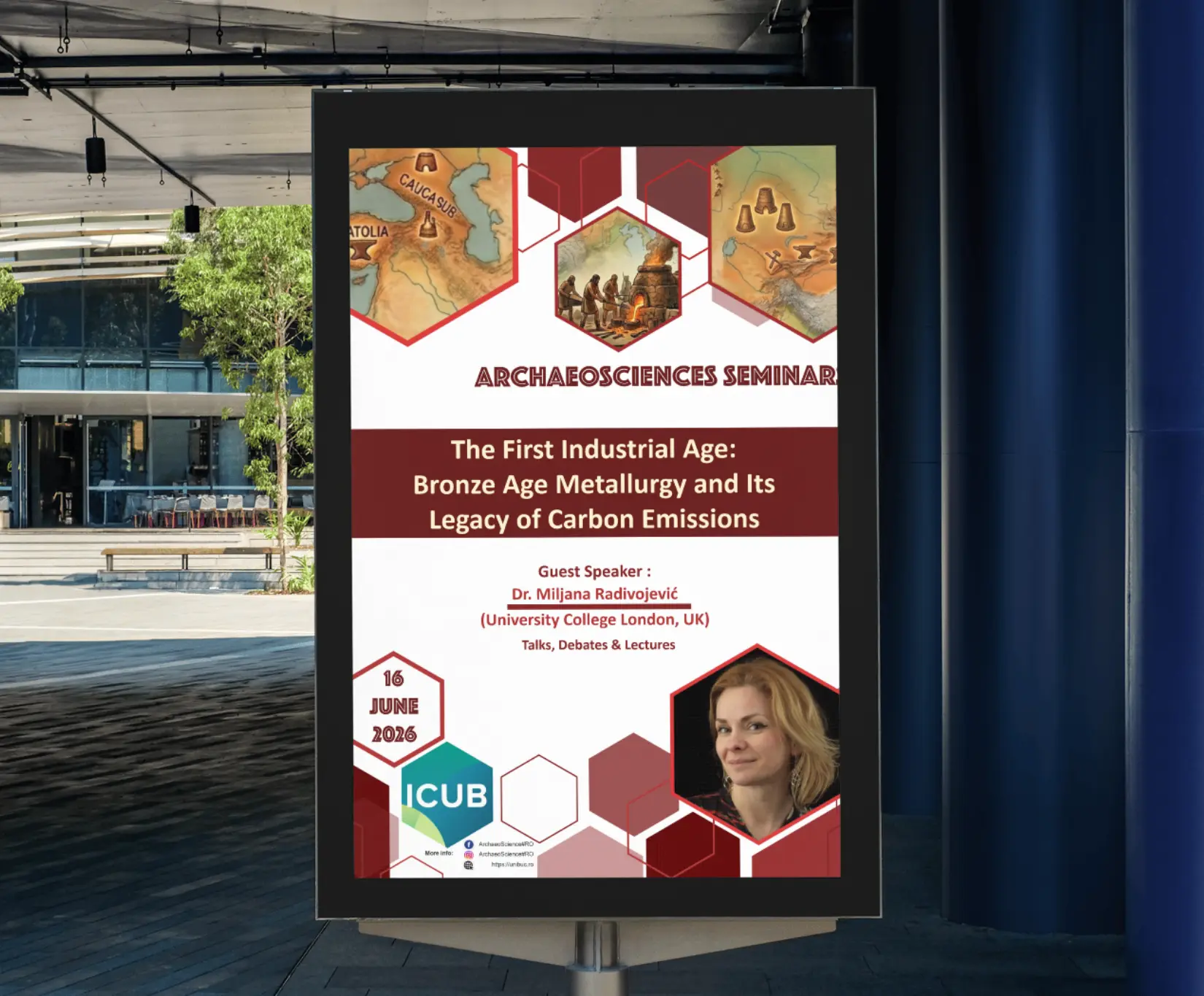
On Tuesday, 16 June 2026, the Research Institute of the University of Bucharest (ICUB) invites you to the 53rd ArchaeoSciences seminar. This edition’s guest speaker is Dr. Miljana Radivojević from the University College London (United Kingdom) who will present a lecture titled “The Earliest Industrial Age: Bronze Age Metallurgy and Its Legacy of Carbon Emissions”.
The seminar will take place starting at 11:00 (EET), at the Seminar classroom (former Herbarium) of the Faculty of Biology building at the Botanical Garden (Intrarea Portocalelor no. 3, basement floor).
About the event
The rise in atmospheric CO2 beginning around 6000 BP remains poorly understood, with few studies addressing its underlying drivers. While increased methane emissions after c. 5000 BP have been linked to the expansion of wet rice agriculture in eastern Eurasia, contemporaneous sources of CO2 have received far less attention. This study presents new evidence for the environmental impact of large-scale Bronze Age copper production in the Eurasian Steppe, proposing a link between metallurgical activity and a 10.2 ppm increase in atmospheric CO2 between 3500 and 1000 BC—comparable in magnitude to the 9.6 ppm rise associated with the Second Industrial Revolution.
Using conservative production models, we estimate that Central Asian mining systems may have produced up to 1.2 million metric tonnes of copper during this period, generating approximately 0.31 Gt of carbon emissions. These findings challenge long-standing assumptions that pre-industrial anthropogenic impacts on the Earth system were negligible, instead positioning the Bronze Age as a potential early “industrial” era driven by extensive extractive practices and pyrotechnological innovation rather than fossil fuels.
A striking discrepancy between estimated copper output and the relatively limited corpus of extant artefacts—requiring billions of objects to account for projected production—points to large-scale recycling, redistribution, and trade, as well as substantial gaps in the archaeological record. This disparity underscores the need to reassess models of artefact circulation, consumption, and deposition across Eurasia.
About the speaker
Dr. Miljana Radivojević is an Associate Professor of Archaeological Science at the UCL Institute of Archaeology and a leading global expert on early Eurasian metallurgy. She is internationally recognised for pioneering big-data and network-science approaches to archaeometallurgy, transforming how archaeologists reconstruct ancient technological innovation, long-distance exchange, and the co-evolution of human cultures and environments. Her research integrates laboratory science, AI-driven modelling, and extensive fieldwork across the Balkans, Central Asia and the Eurasian Steppe, producing a new paradigm for interpreting prehistoric cultural systems from legacy datasets.
Dr. Radivojević has held research positions at the University of Cambridge, UCL, and the University of Belgrade, including the Renfrew Anniversary Research Fellowship at the McDonald Institute for Archaeological Research. She has published extensively on the origins and spread of metallurgy, the emergence of early mining and smelting centres, and the methodological foundations of compositional and isotopic analysis. She obtained her PhD in Archaeometallurgy from UCL in 2012.
She has secured over €2.9 million in competitive research funding, including a prestigious ERC Consolidator Grant (2024–2029) as Principal Investigator for the project DREAM – Discovering the (R)Evolution of Eurasian Metallurgy, hosted at UCL and underwritten by UKRI. Her funding portfolio spans national and international agencies (AHRC, British Academy, Fyssen Foundation, EPSRC, Kazakhstan Government), reflecting her leadership in interdisciplinary archaeological science.
These seminars are an original initiative of the ArchaeoSciences Platform (ASp) at ICUB, which aims to provide an open space for professionals in archaeological sciences worldwide to share knowledge and engage with the latest methodological and theoretical advances in the study of the past. They also offer Romanian students a valuable opportunity to discover the interdisciplinary dimensions of archaeology and archaeosciences.
Postări asemănătoare:
 ICUB invites you to the lecture „EPMA and its potential applications in archaeochemistry”, delivered by Dr. Gelu Costin from Rice University, Houston, Texas
 ICUB invites you to the lecture “Off the beaten track: The Significance of the Black Sea Regions for European Neolithization”, delivered by Dr. Marta Andriiovych from the University of Oxford and the University of Bern
 ICUB invites you to the lecture „Burning Questions from a Prehistoric Backwater: Reexamining Chalcolithic Cyprus”, delivered by Dr. Victor Klinkenberg from the University of Cyprus
