




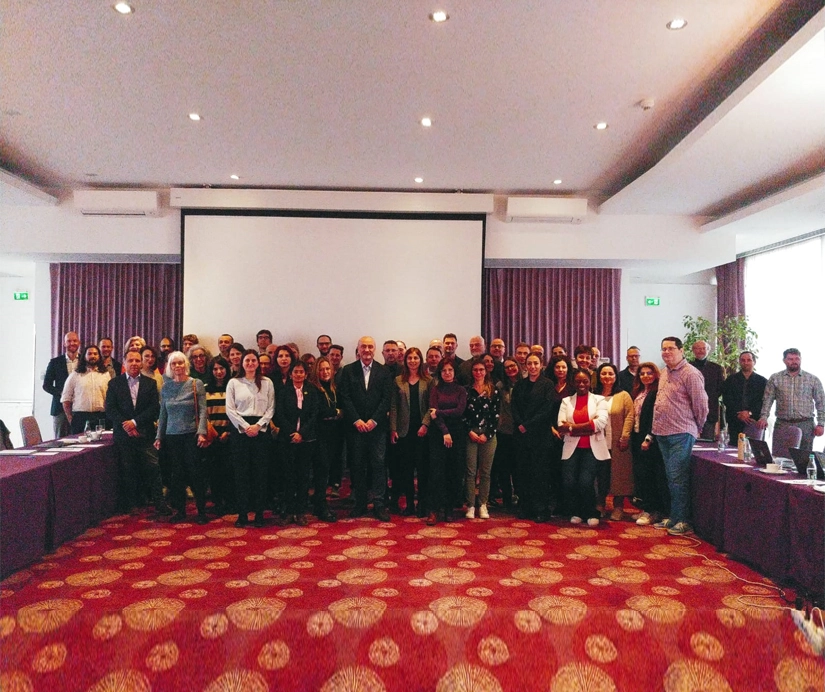
Between March 12th – 13th 2024, Bucharest hosted the launching event for the project Climate-Resilient Development Pathways in Metropolitan Regions of Europe/ CARMINE, coordinated by the National Meteorological Administration (ANM) whom UB is partner with, through the Centre for Environmental Research and Impact Studies (CCMESI) of the Faculty of Geography.
The director of the program is professor Sorin Cheval, PhD, who teaches at the Department of Regional Geography and Environment of the UB Faculty of Geography and is a researcher at ANM.
Project partners representatives attended the event and engaged in interactive debates concerning the central scientific concepts of the project, discussing ways to identify the best practices for the implementation of the project. All attendees expressed their optimism concerning the manner in which the results of the CARMINE project can contribute to creating a Europe more resilient to climate on mid- and long-term.
CARMINE will be implemented between 2024-2028 by a consortium comprising 31 partner universities, research institutes, private companies, public institutions and international organizations from 11 countries: Romania, Italy, Greece, France, Spain, Germany, Belgium, Denmark, the Czech Republic, UK, Switzerland.
Supporting metropolitan communities in becoming more resilient to climate change
The goal of the CARMINE project is to help metropolitan communities become more resilient to climate change, by coproducing instruments based on knowledge, strategies and action plans for adaptation and attenuation.
The CARMINE project aims to: co-create and co-develop decisional support services and directive guides for a stronger resilience and adaptation capacity, including early warnings; to cooperate with local and metropolitan communities in order to jointly develop trans-sectoral frames for adaption and attenuation actions; to provide roadmaps based on science for climate government on several level, which can support evaluations and local adaptation plans.
The European Union’s strategy for Adapting to Climate Change
Current realities highlight an increase in the frequency and intensity of meteorological and climate extremes associated with climate change, whose projection is getting more obvious at local and regional level. These changes require adequate reactions at local and regional level, foremost directed towards adaptation to climate change, with priority in metropolitan areas. The strategy of EU concerning climate change recognizes that: there is insufficient knowledge to support decision-making; there are deficiencies in implementing, monitoring and reporting adaptation actions to climate change, and there are delays in implementing adaptation actions.
Metropolitan areas of Europe, defined as conglomerations of at least 250.000 people, are very heterogeneous socio-ecological systems, with multiple stress factors and processes that interact at different levels, from local (municipal) scale to regional scale (regions of development). They concentrate the largest part of Europe’s population, being, as such, a priority for planned intervention for improving climate resilience.
In order to build climate resilient communities, climate change adaptation plans for metropolitan areas must be guided by data and models which encompass the relevant processes and interactions at adequate scales. As such, there is an urgent need to produce high resolution climate data, which are to be correlated with socio-ecologic and technological variables.
In order to support metropolitan communities to become climate resilient by 2030, the project investigates the impact of climate change at local scale, studies the answers and behavioral changes of society and develops adaptation solutions to climate change.
The project integrates innovative approaches, which significatively contribute to its complexity:
- Living Labs (LL) real and virtual in each study case, as open spaces which reunite scientists and different categories of stakeholders to facilitate their involvement in the process of co-designing to enable the development of adaptation solutions for climate change.
- Digital Twins Simulations (DT), proposing the virtual representation of metropolitan systems, in order to promote and support intersectoral resilience to climate change and managing climate disaster risks.
- Nature-based solutions (NBS), that have to play a more important role in managing land use and planning infrastructure to reduce costs, to provide climate resistant services and to improve climate resilience.
- AI (AI), modelling and automated learning (ML), used to increase the resolution of existing models by integrating natural and anthropic factors.
- Simulation chains, which necessitate the co-developing, testing and validation of a simulation frame on several scales in order to support the assessment of the impact at local scale.
Thus,CARMINE starts from the detailed approach of eight study cases, in which Living Labs will be established and risks and climate vulnerabilities will be analyzed, in order to jointly design decision making instruments and propose climate resilient development paths. Study cases are represented by eight metropolitan areas in eight countries, with different socio-economic profiles, types of communities, vulnerabilities, impact factors concerning climate and geographical distribution in Europe: Prague, Leipzig, Funen-Odense, Athens, Barcelona, Bologna, Brașov and Birmingham.
Professor Sorin Cheval, PhD, highlighted that the project has a high complexity level, due not only to the objectives and very ambitious and innovative work methods, but also by the extremely high quality and diverse profile of the institutions and researchers involved. The fact that we managed to win such a project, with a coordinating institution from Romania, the National Meteorological Administration, proves that we have managed to build, in time, a positive image of Romanian research in the field of climate change research.
It is an honor to be part of a team that wishes to contribute to the increase of accessibility and using scientific information in decision-making processes which are relevant for the improvement of climate resilience in metropolitan areas. Previous experiences of the Centre for Environmental Research and Impact Studies in assessing the quality of the environmental planning documents, in the development of climate change adaptation plans at local level and in promoting nature-based solutions to increase the resilience and sustainability of cities, will most certainly be useful in the CARMINE project ecosystem, said professor Cristian Ioja, PhD, project representative and teaching staff at the UB Faculty of Geography.
More details on the project Climate-Resilient Development Pathways in Metropolitan Regions of Europe/ CARMINE are available here.
SECŢIUNE ACCESIBILIZATĂ PENTRU PERSOANELE CU DIZABILITĂŢI DE VEDERE
Postări asemănătoare:
 The University of Bucharest, involved in the Horizon Europe “BioAgora” project through the Center for Research in Systemic Ecology and Sustainability
 The University of Bucharest is part of a consortium that studies the effects of global warming and climatic extremes on some waterborne diseases. The research project is financed by a Horizon Europe grant and has a budget of €6.5 million
 Two scientific world firsts achieved as part of a project carried out by the Faculty of Geography of the University of Bucharest, the first drilling in permafrost in South-Eastern Europe
