



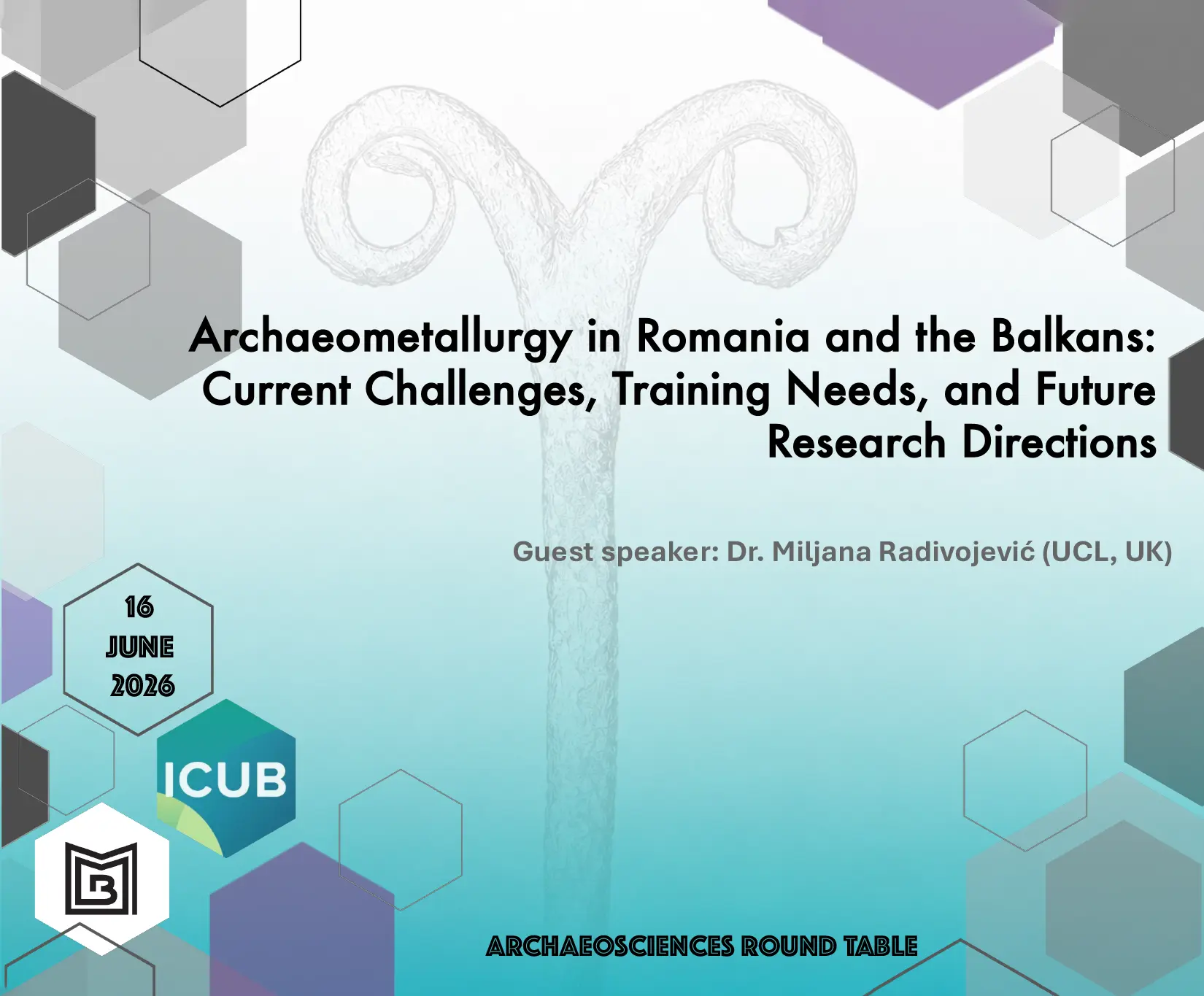
On Tuesday, 16 June 2026, the ArchaeoSciences Platform (ASp) of the Research Institute of the University of Bucharest (ICUB), in collaboration with the Bucharest Municipality Museum, organised the round table entitled “Archaeometallurgy in Romania and the Balkans: Current Challenges, Training Needs, and Future Research Directions.”
The event took place at the Faculty of Biology, Botanical Garden Building, and brought together specialists from the University of Bucharest, the “Vasile Pârvan” Institute of Archaeology of the Romanian Academy, and the Horia Hulubei National Institute for Research and Development in Physics and Nuclear Engineering (IFIN-HH).
The special guest of the meeting was Dr Miljana Radivojević, Associate Professor at University College London and a specialist in archaeometallurgy and the study of the beginnings of prehistoric metallurgy. Her expertise in early metallurgical technologies and in integrating materials analysis into archaeological interpretation provided the starting point for the interdisciplinary discussion.
The discussions assessed the current state of archaeometallurgical research in Romania and the Balkan region, with particular emphasis on existing expertise, available analytical infrastructure, and opportunities for cooperation between archaeology, physics, chemistry, geology, conservation, and materials science.
The dialogue also highlighted the need to develop interdisciplinary training programmes for students, doctoral researchers, and early-career scholars. Participants discussed the possibility of organising courses and practical training placements, improving access to specialised research infrastructure, and involving young researchers in projects that combine archaeological fieldwork with advanced analytical methods.
The priority directions identified during the meeting included:
- developing shared protocols for sampling, analysis, documentation, and conservation;
- improving the comparability of data generated by different laboratories and research projects;
- creating and using reference collections;
- strengthening cooperation between archaeological institutions and scientific research infrastructures;
- organising joint training and mobility activities;
- preparing interdisciplinary and international projects dedicated to prehistoric archaeometallurgy.
The round table provided an applied framework for the exchange of expertise among specialists and for identifying shared research objectives. By bringing together archaeological and analytical perspectives, the meeting contributed to strengthening inter-institutional dialogue and defining sustainable directions for the development of archaeometallurgy in Romania and the wider Balkan region.
The event continued the ArchaeoSciences Round Table series, initiated by the ArchaeoSciences Platform–ICUB to encourage interdisciplinary dialogue, connect archaeological research with modern laboratory infrastructures, and develop long-term academic collaborations.
Postări asemănătoare:
 ArchaeoSciences Round Table: Paleogenetic & Archaeology Perspectives in Romania #2
 ICUB invites you to the ArchaeoSciences Round Table Palaeogenetics & Archaeology Perspectives in Romania #3
 A new trademark ASp-ICUB event: ArchaeoSciences Round Table: Paleogenetic & Archaeology Perspectives in Romania #4
 ArchaeoSciences Round Table: Paleogenetic & Archaeology Perspectives in Romania #5
