




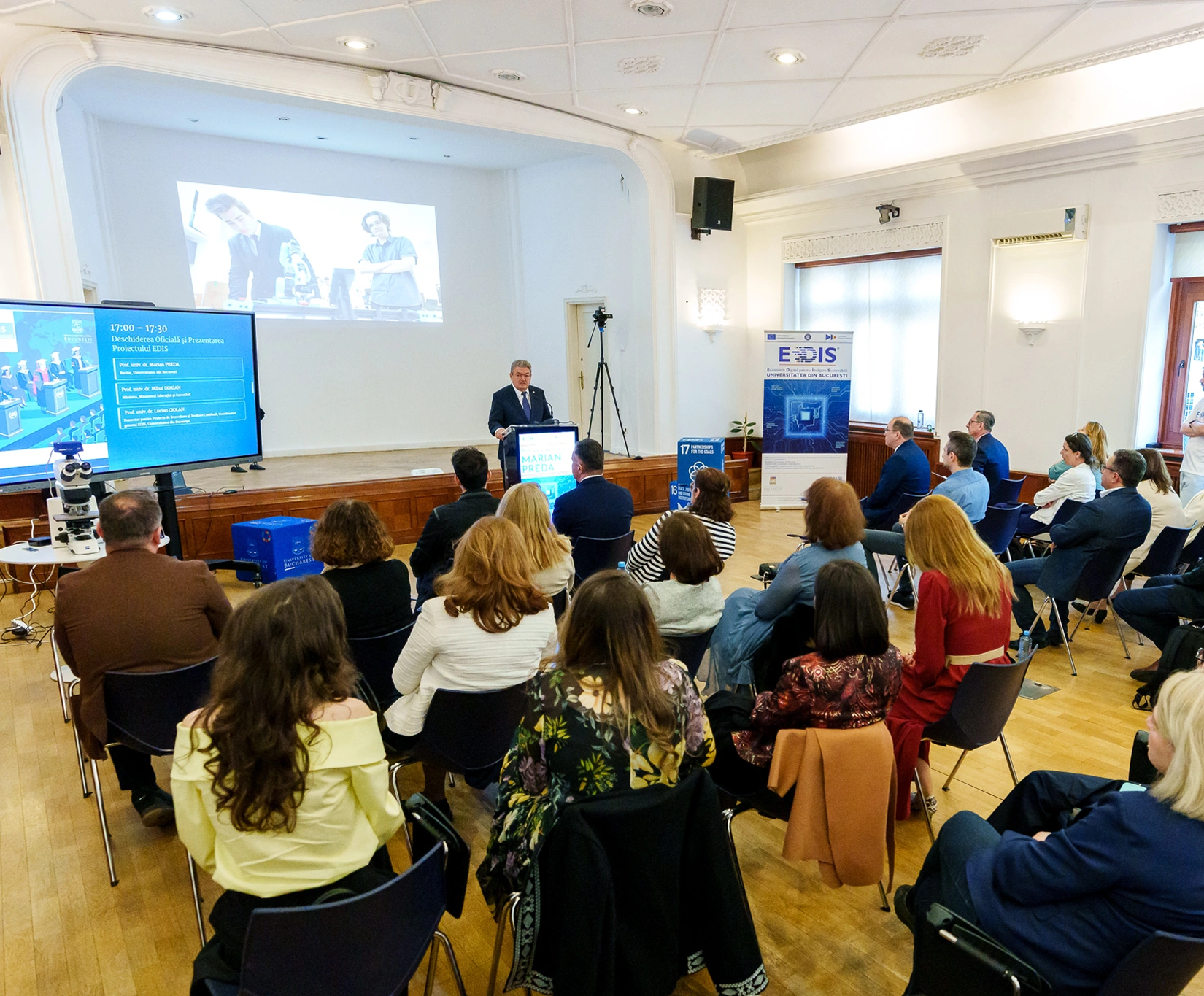
The University of Bucharest hosted, on Monday, April 20, 2026, the results dissemination conference of the project “Digital Ecosystem for Sustainable Learning – EDIS-UB,” an event dedicated to transforming education through technology and innovation. The conference brought together representatives of the academic community, education policymakers, and digitalization experts, offering a comprehensive overview of the strategic directions through which the University of Bucharest aims to adapt the learning process to future demands.
The event opened with a session highlighting the importance of investment in digital infrastructure and in the development of skills required in a constantly evolving society. Among the speakers were sociologist Marian Preda, Rector of the University of Bucharest, Mihai Dimian, Minister of Education, and Lucian Ciolan, or Development Projects, Lifelong Learning and Educational Infrastructure and General Coordinator of the EDIS-UB project.
They emphasized the essential role of universities in building a sustainable, student-centered educational ecosystem supported by technology.
Marian Preda noted that the project, developed over several years and supported by an investment of approximately 44 million lei, marks not only the completion of a major development process but also the beginning of a new stage for the university. He highlighted the modernization of educational infrastructure across most faculties, the development of digital laboratories, and the meaningful integration of technology into teaching, research, and academic collaboration.
Minister Mihai Dimian emphasized the scale of national investments in education digitalization, noting that dozens of projects and over one billion lei have been allocated to modernizing educational infrastructure. These efforts include thousands of laboratories and updated study programs aligned with new digital requirements. At the same time, he stressed that the real challenge begins now: making effective use of these resources to generate meaningful impact in teaching and research.
Lucian Ciolan highlighted the project’s integrated and transformative nature, explaining that EDIS-UB goes beyond a simple technological upgrade. Instead, it creates a coherent digital ecosystem that brings together technology, human resources, and pedagogical innovation.
The project supports teaching, learning, research, and administration through shared and interoperable infrastructures, while also investing in the development of digital skills for both faculty and students. Its long-term goal is to ensure sustainability and fully integrate these solutions into everyday academic practice.
The series of thematic presentations began with Cosmin Olteanu, project manager and associate professor at the Faculty of Administration and Business, who discussed the growing role of humanoid robots in everyday life. He emphasized how human–AI interaction is becoming increasingly relevant, including in education, where such technologies can support personalized learning.
He also underlined that acquiring technology is only the first step – the real transformation lies in how it changes teaching, research, and collaboration practices, as well as in the development of digital competencies, particularly in artificial intelligence.
Lecturer Anișoara Dumitrache introduced the concept of Innovative Pedagogy Laboratories – spaces designed for experimenting with modern teaching methods. These labs integrate emerging technologies such as virtual and mixed reality, 3D printing, and AI, enabling interactive, accessible, and personalized learning experiences.
Associate Professor Bianca Gălățeanu presented the digital microscopy laboratory developed within the project, showcasing how digital tools enable real-time analysis, collaboration, and high-resolution visualization of biological samples. Participants were able to observe firsthand how advanced microscopy systems transform traditional laboratory work into an interactive digital experience.
Another key component presented was GIPAS (Integrated Management of the Student Academic Path), a system dedicated to developing and assessing digital competencies in line with European standards such as DigComp and DigCompEdu. The platform has already trained hundreds of students and faculty members and supports a wide range of competencies, from basic digital skills to emerging fields like AI auditing and entrepreneurship in the Metaverse.
Complementing GIPAS is MOPAS (Online Management of Students’ Academic Path), presented by Oana Sârbu. This system streamlines administrative processes for the university’s ecosystem of approximately 36,000 students, 3,500 faculty members, and over 20,000 courses annually. By integrating with platforms such as Moodle and other institutional systems, MOPAS creates a seamless digital experience for both students and staff.
The implementation of EDIS-UB marks a decisive step in transforming the University of Bucharest into a student-centered institution, where digital services reduce bureaucracy and enhance the academic experience.
As Cosmin Olteanu concluded, the project is not just about infrastructure, but about reshaping how learning and collaboration take place within the university. Its long-term impact will depend on how deeply these digital practices become embedded in academic culture.
EDIS® is a registered trademark of the University of Bucharest (no. M202404339) with the Romanian State Office for Inventions and Trademarks. The “Digital Ecosystem for Sustainable Learning at the University of Bucharest – EDIS-UB” project (code 1828329254), with a total value of 51,562,666 lei, was implemented over three years (September 16, 2022 – March 31, 2026) and funded through the National Recovery and Resilience Plan, Component C15 – “Digitalization of Education.”
Postări asemănătoare:
 The University of Bucharest takes part in the 35th edition of the UNICA General Assembly & Rectors’ Seminar, hosted by the National and Kapodistrian University of Athens
 Call For Applications for the National Conference of the Community “Education for Science” – “Looking at the Future: STEM Education perspectives. Lessons from the Crisis” –
 “Millions of invisible lives within our bodies shape our health and well-being” – Prof. Carmen Chifiriuc, PhD guest of the first edition of the “Science on the open stage” conference series
 When extremes become the norm: Bogdan Antonescu takes the stage at the University of Bucharest
