



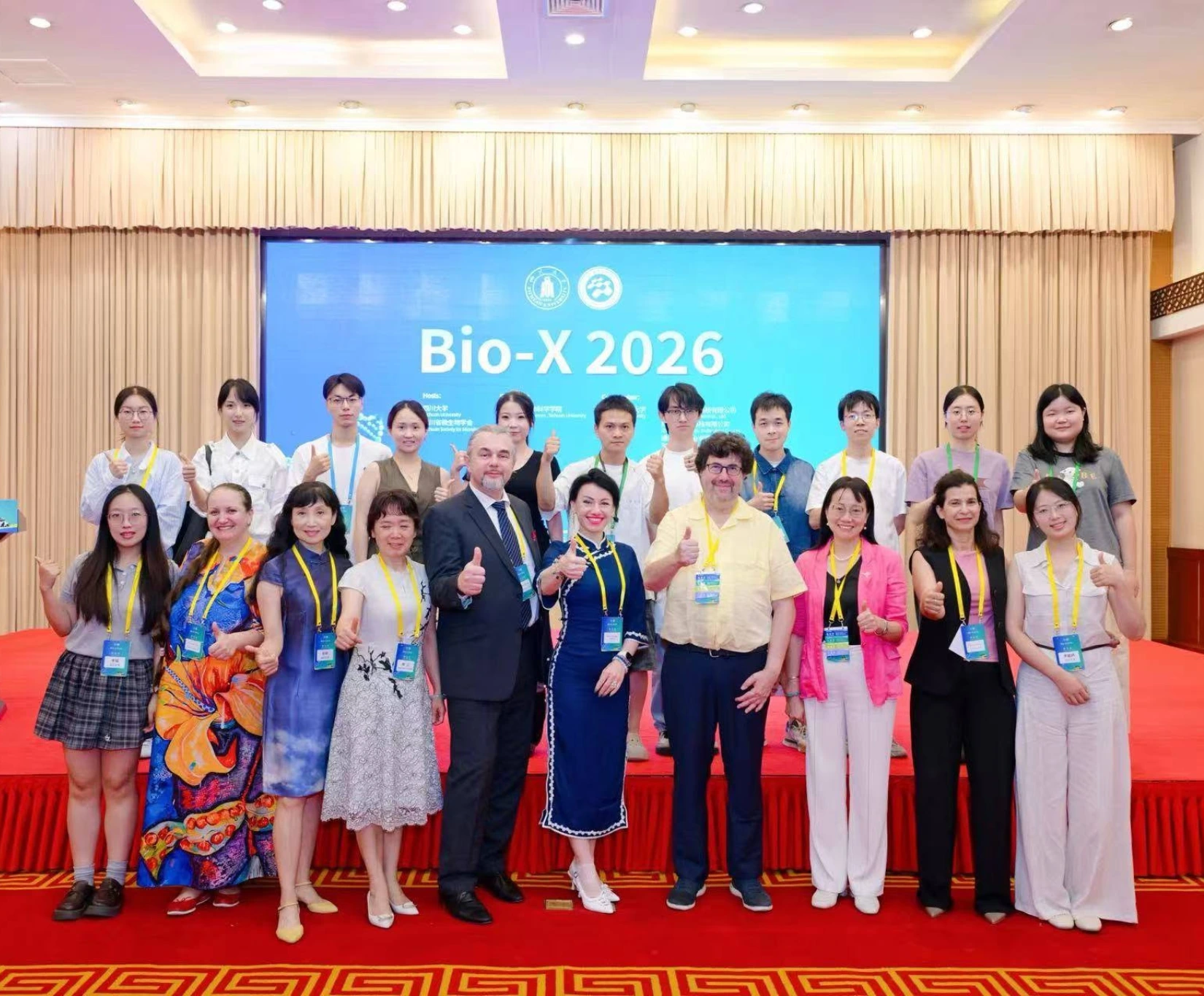
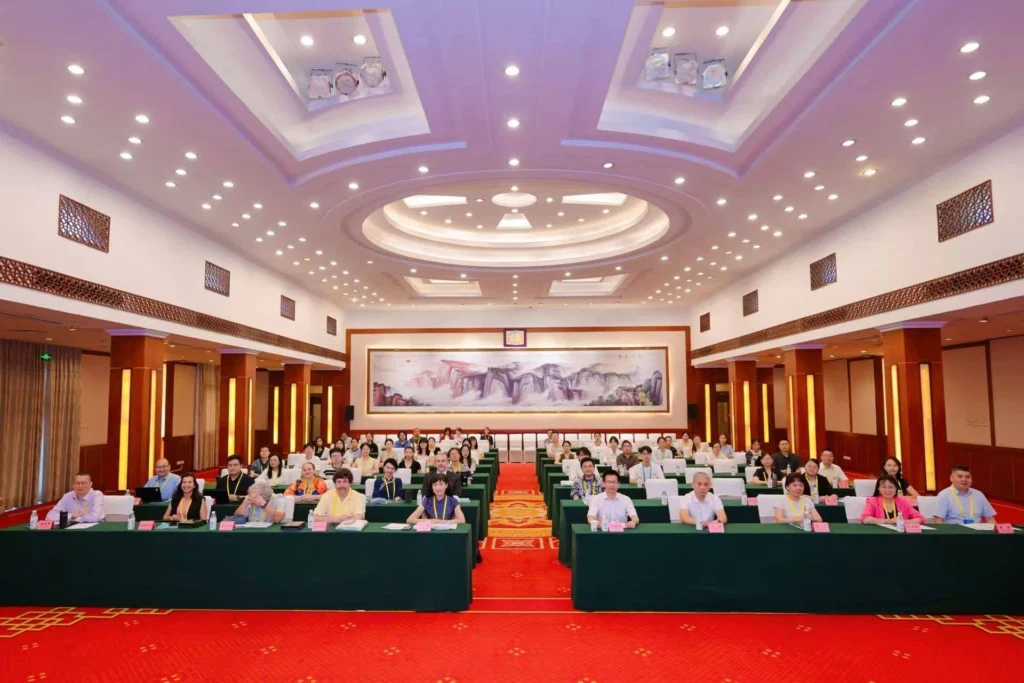
Between 23 and 26 August 2026, Chengdu hosted the Bio-X International Academic Conference 2026, an event organized by Sichuan University and the Sichuan Society for Microbiology, in collaboration with Ben-Gurion University, Israel, under the theme “Interdisciplinary Innovation · Future of Life.”
Dr. Maria Iasmina Moza, assistant professor and researcher at the Faculty of Biology, University of Bucharest, represented Romania at Bio-X 2026 through a plenary presentation, her activity as a member of the International Scientific Committee, and the involvement of students from the Faculty of Biology in an international scientific contribution.
From research carried out in laboratories in Romania to the international scientific stage in Chengdu, China – this is the story of a passion for mycology and applied microbiology that has crossed borders and brought Romanian research before an international scientific community.
The event brought together researchers and specialists from fields such as biology, medicine, engineering, bioinformatics, biosensors, biotechnology, synthetic biology, nanomedicine, and environmental biotechnology, placing interdisciplinary collaboration and the development of new directions in the life sciences at its core.
Dr. Maria Iasmina Moza delivered a plenary presentation, through which she had the opportunity to present to the international scientific community research directions and results developed in the fields of mycology, microbiology, and applied biological investigations, particularly in the area of cultural heritage.
At the same time, Dr. Maria Iasmina Moza was a member of the International Scientific Committee of Bio-X 2026, contributing to the academic dimension of the event and to the dialogue between researchers from different scientific and geographical backgrounds, while also establishing future collaborations with China, Israel, and Australia.
Romanian mycology and a new generation of researchers – in Chengdu and beyond
A particularly important aspect of this participation was the presentation of research results obtained together with students in an international scientific setting.
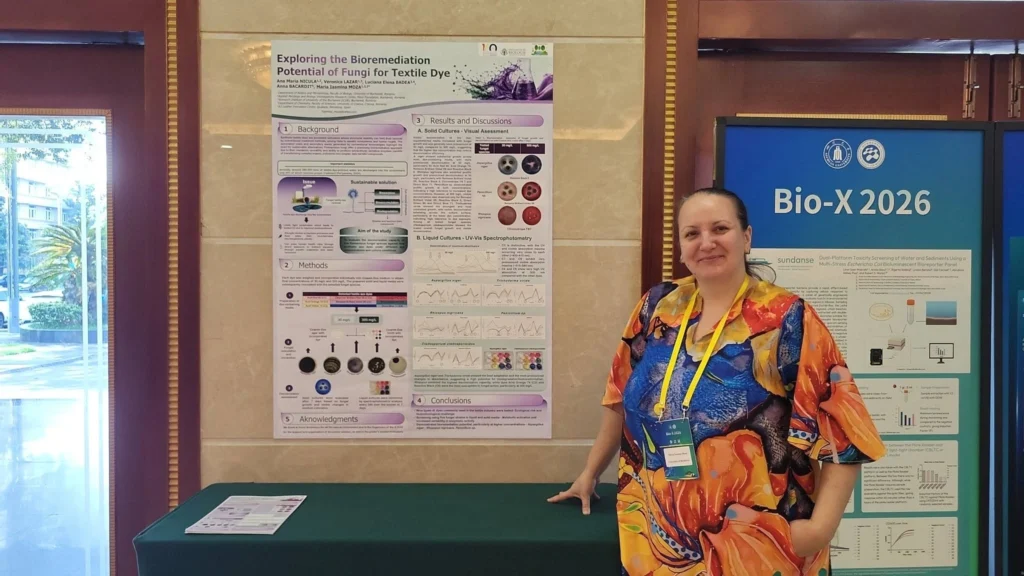
At Bio-X 2026, a poster developed in collaboration with Ana Nicula, a student in the Master’s programme Applied Microbiology and Immunology at the Faculty of Biology, University of Bucharest, was presented. Another student, Alice Ifrim, an undergraduate student, was a co-author of the plenary presentation.
“Ana, for example, is not experiencing for the first time the international presentation of results we have obtained together, nor is she the only student I collaborate with. I present and offer this opportunity to all the students I work with. Ana, in particular, is part of the first group of students I supervise, and last year she also received First Prize at another international scientific event in Israel. But the other students I work with, including those at an earlier stage of their studies, are also co-authors, have already presented, or are preparing to present orally at several major scientific events before the end of the year. It is wonderful when this happens, and what is most rewarding for me is being able to go beyond the boundaries of the standard curriculum without much difficulty and offer interested students something more than standardized laboratory classes. To be honest, that is also what motivates me!” says Dr. Maria Iasmina Moza.
Through this contribution, the research carried out within the Faculty of Biology was presented as a space for training the next generation of scientists.
The participation of students in international scientific events gives them the opportunity to present their results, interact with researchers from other countries, receive scientific feedback, and develop – already during their studies – the skills necessary for a career in research. Such opportunities should be an integral part of the educational process, even when they are not formally included in the curriculum.
Dr. Maria Iasmina Moza on mentoring and international scientific experience
Although still in the early years of her mentoring career, Dr. Maria Iasmina Moza has made it a practice to introduce students to such events and emphasizes their importance:
“Bringing a student – or, in this case, their contribution – into such an international environment means more than presenting a poster or a plenary presentation together. It means giving them their first direct experience within a global scientific community and the opportunity to learn, step by step, how an international academic path is built. It also means helping them develop and strengthen the confidence and skills necessary to represent themselves and us independently and successfully at such events in the future.
I know that we are living through a period of financial constraints, but I would very much like there to be institutional and national funding dedicated also to undergraduate and Master’s students who achieve strong results — not only to PhD and postdoctoral researchers or University of Bucharest employees – so that they can travel alongside their mentors to such major scientific events, particularly when their mentors do not have research grants or other financial resources beyond the support provided by the University of Bucharest.
I would like to take this opportunity to officially thank the leadership of the University of Bucharest, the Vice-Rectors, and the Department of Doctoral Schools for their financial support and trust, as well as the administrative staff, who have been highly enthusiastic and willing to support such events. Last but not least, I would like to thank all my students for choosing me as their mentor and for being such wonderful junior collaborators. We have already participated in events together and will take part in several more scientific conferences before the end of the year, despite all the financial efforts involved.”
This educational and formative dimension reflects one of the essential values of university research: transforming today’s scientific results into the skills and ideas of tomorrow’s researchers.
A conference built around interdisciplinarity
Bio-X has an important history of promoting collaboration between different fields. The event was initiated in 2006 by Ben-Gurion University of the Negev, by Prof. Robert Marks, and was conceived as an international event dedicated to biotechnology and interdisciplinary research. Over time, it developed into a platform for dialogue between the life sciences, medicine, engineering, and technology.
The Bio-X 2026 edition in Chengdu continued this vision, bringing together an exceptionally diverse range of fields — from biochips, biosensors, and diagnostic technologies to artificial intelligence and biomedicine, synthetic biology, bioinformatics, environmental biotechnology, and agricultural biotechnology.
This interdisciplinary approach is one of the remarkable aspects of the event. At a time when the complex challenges facing society can no longer be addressed in isolation, building genuine bridges between disciplines and scientific communities is becoming essential for progress.
Special thanks are extended to Sichuan University, Prof. Qun Sun, the Sichuan Society for Microbiology, and everyone involved in organizing Bio-X 2026 for their professionalism, hospitality, and the attention given to every participant.
The organization of the event in Chengdu demonstrated that a scientific congress can become a genuine meeting place between disciplines, generations, cultures, and academic communities.
Such an initiative also reflects the importance that China places on the development of science through cooperation, the integration of disciplines, and the creation of international platforms for dialogue – values that deserve to be appreciated and supported by the international scientific community.
From participation to future collaboration
Following participation in the event, initiatives are already underway with the aim of organizing a future edition of Bio-X in Romania, creating an opportunity to bring international researchers and specialists closer to the Romanian academic community.
Such an initiative could contribute to expanding and strengthening collaboration between Romanian researchers and international partners, developing joint projects, and increasing Romania’s visibility as a space for research, innovation, and cooperation in the life sciences.
For the University of Bucharest, such an initiative would also represent an opportunity to provide its researchers and students with access to an international scientific community and to transform the collaborations established in Chengdu into new projects, new opportunities, and new generations of researchers connected to the global scientific community.
More information about Bio-X 2026 is available on the conference’s official webpage.
Chengdu – a new frontier for Romanian research
Chengdu was the place where Romanian research crossed a new frontier.
“And, to tell you something about my personal experience during my first visit to China: I absolutely loved it and felt a particular sense of openness and warmth. I do not know whether this was due to the welcoming organizers and the exceptional group of participants, or perhaps to the region itself, but there will certainly be many collaborations in the future.
And if the efforts to organize a future edition of Bio-X in Romania become a reality, this collaboration will make the journey in the opposite direction: from Chengdu to Romania. I hope that, with the support of the University of Bucharest, we will be able to offer our colleagues a unique experience, both personally and scientifically.”
From Bucharest to Chengdu and, perhaps, from Chengdu back to Bucharest – Romanian mycology continues its journey across borders, while a new generation of researchers is already part of that journey.
Postări asemănătoare:
 Interested in mycology and related fields? ICUB and the Faculty of Biology invites you to the University of Bucharest Mycology Club (UBMC)
 The University of Bucharest launches „Harta cercetătorilor UB” (UB Researchers’ Map), an interactive platform designed to make researchers’ international presence more transparent and visible
 Call for Junior Researchers in the frame of the PRESILIENT project: Post-pandemic resilient communities: is the informal economy a reservoir for the next generation of digitalized and green businesses in Africa, Asia, and Latin America?
 On Saturday, 24 January 2026, the University of Bucharest marked the start of a scientific expedition to Antarctica, involving four researchers from the University of Bucharest and the National Institute for Research and Development for Biological Sciences (INCDSB)
